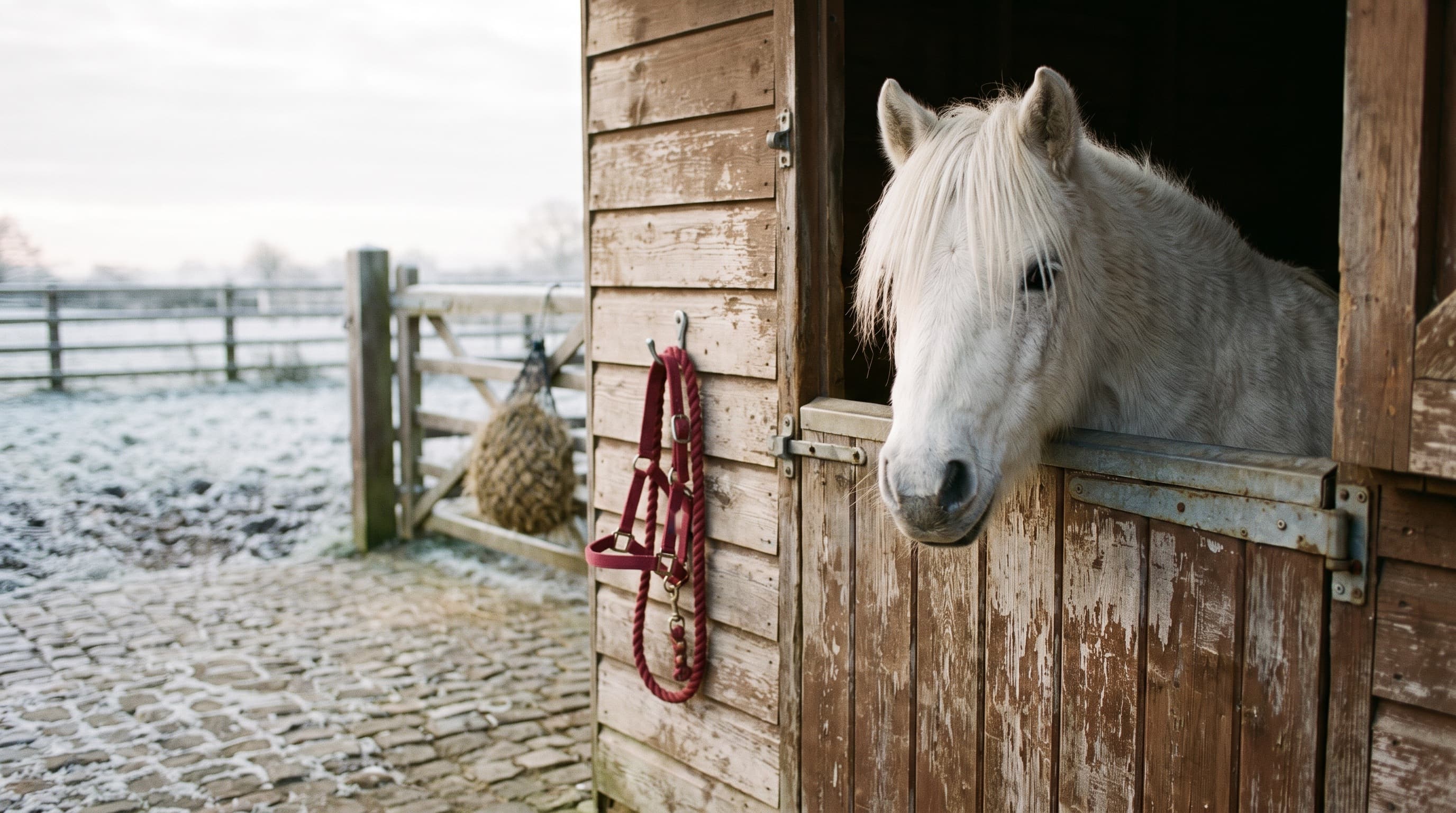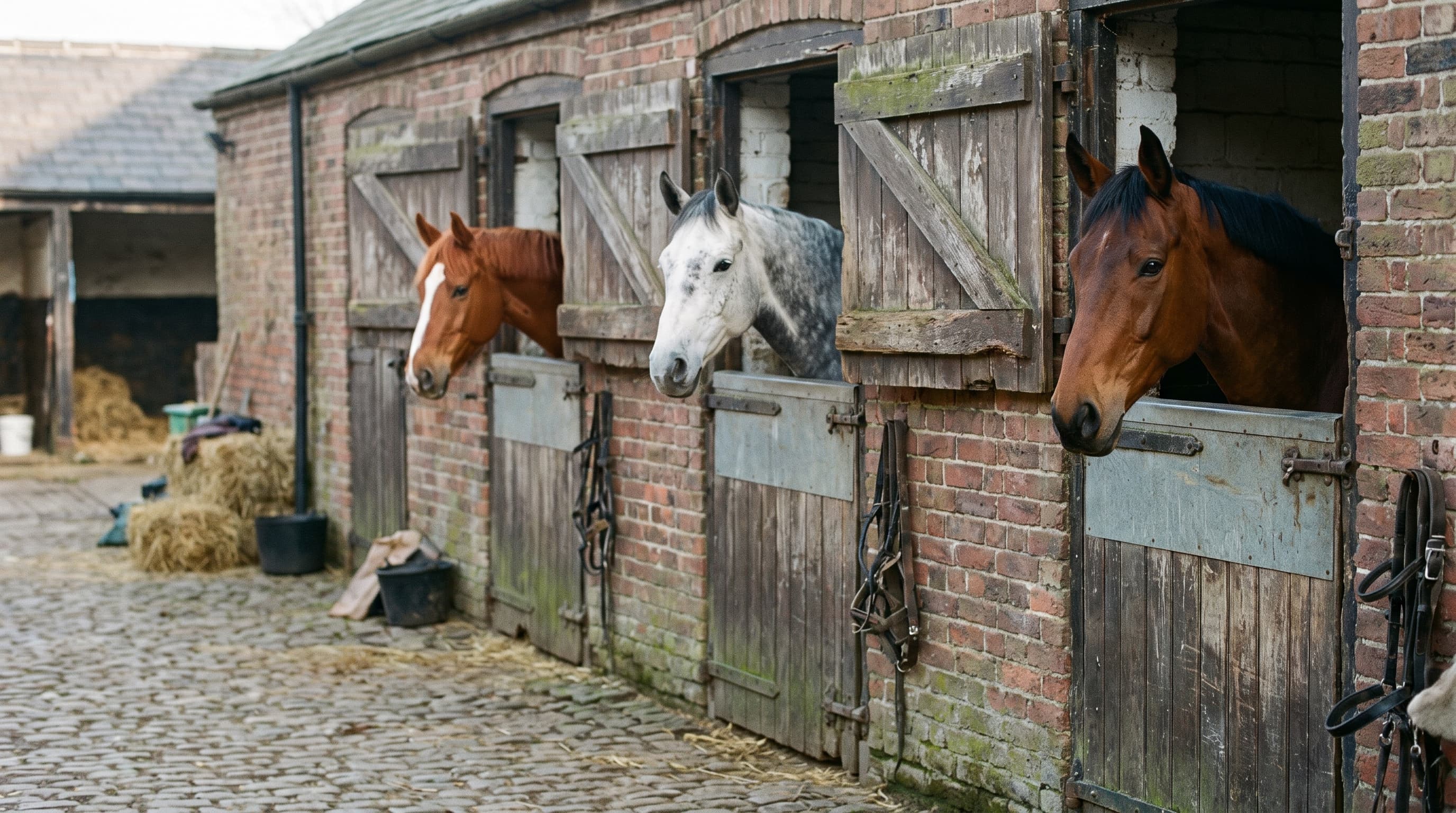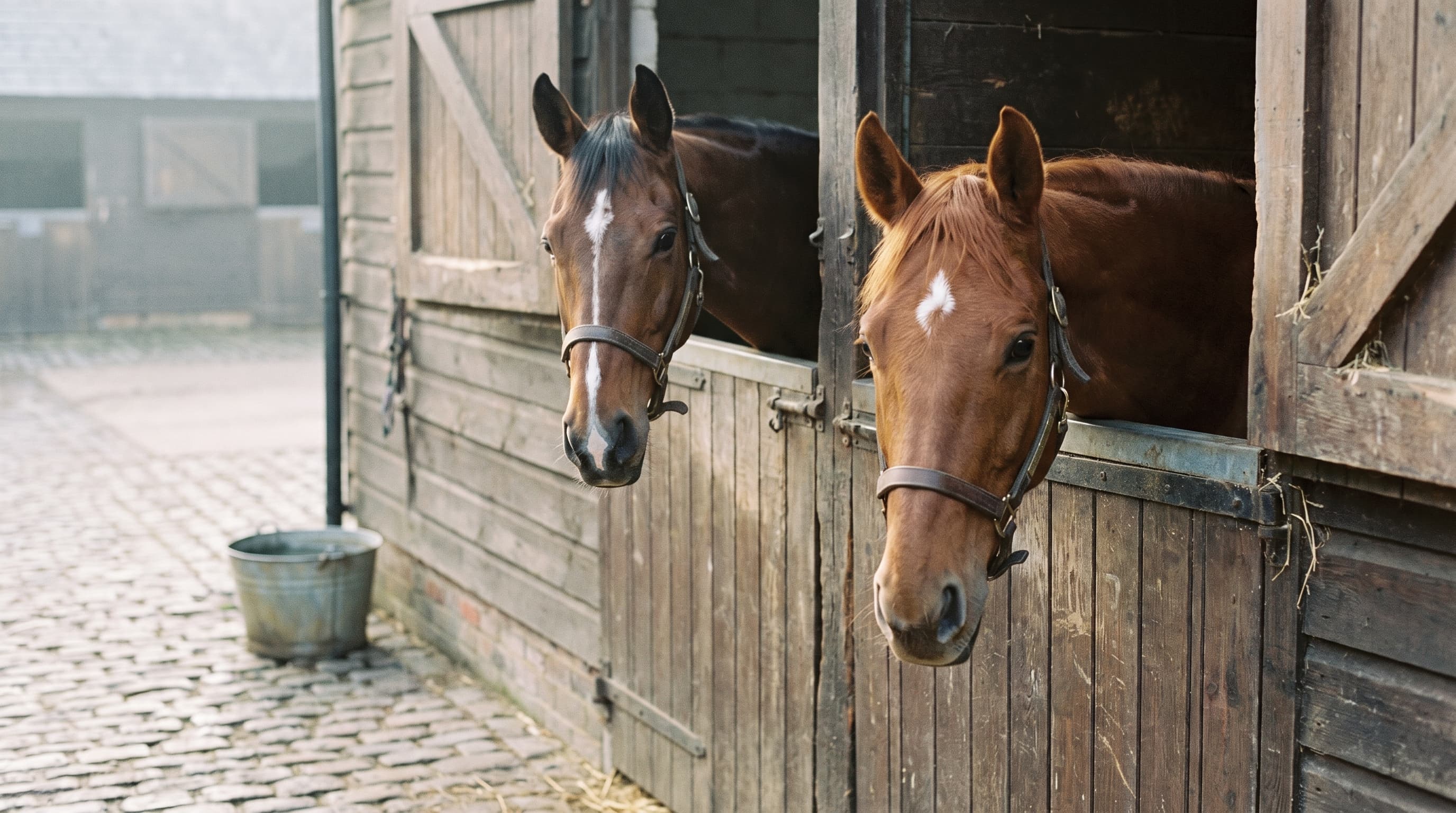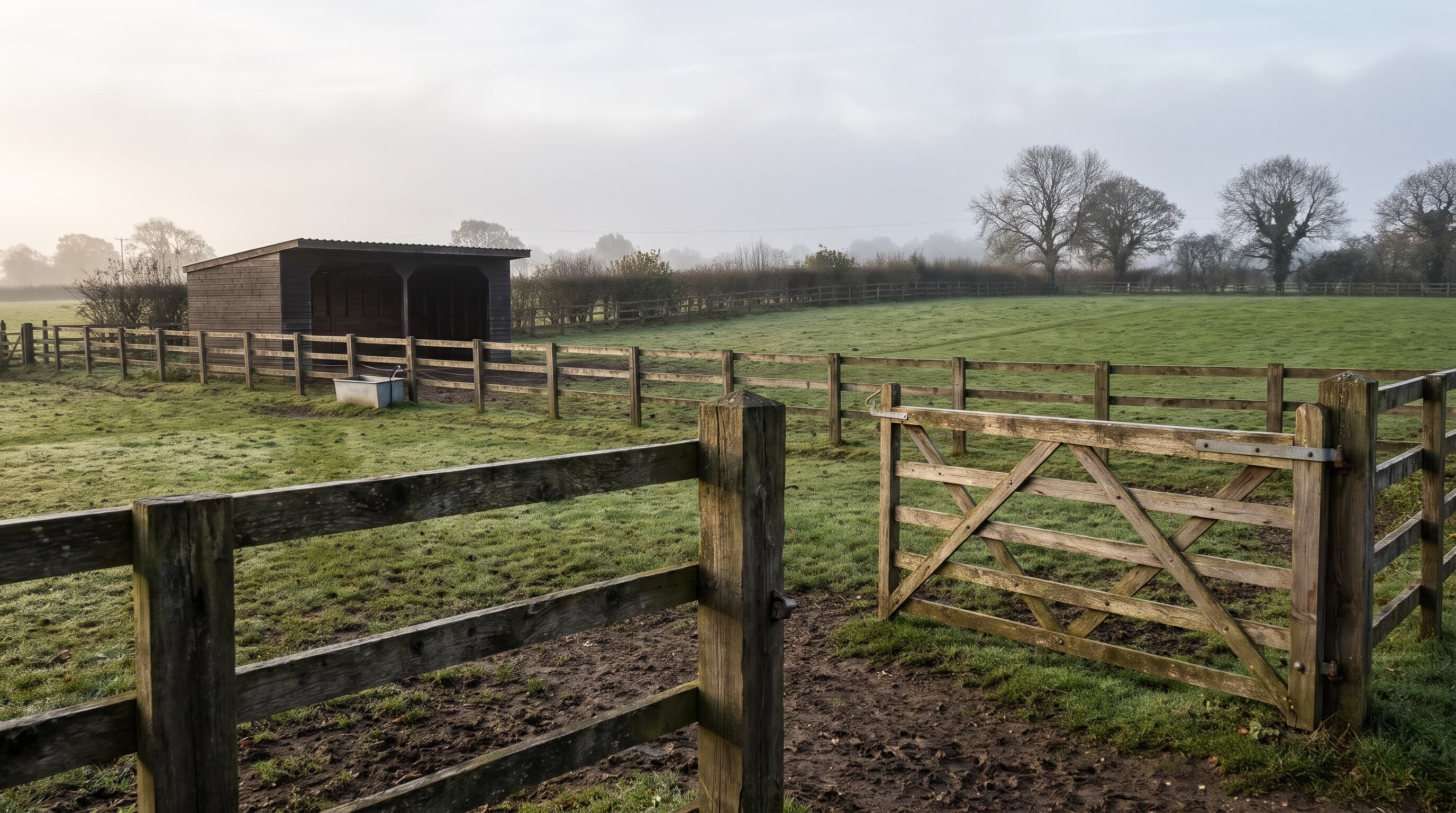
The listing says "house with stables and four acres", and you are doing the sum in your head on the drive home. How much land does a horse need has two honest answers: England's welfare code puts it at 0.5 to 1 hectare (1.25 to 2.5 acres) of good grazing per horse if the grass is its whole diet, and US extension services say 1.5 to 2 acres of well-managed open land. A horse that lives mainly on hay needs far less, but never only a box.
This is for the buyer looking at a horse property or a first yard: what each country's guidance publishes, why the figures disagree, how big a box should be, and what to check before a viewing.
How much land does a horse need for grazing
Of the countries we checked, only England and the US put a grazing figure on a single horse, and both hedge it. England's Code of Practice for the Welfare of Horses, Ponies, Donkeys and Their Hybrids, issued by Defra under the Animal Welfare Act, says the area "will depend on the type of grass, ground conditions, time of year, type of horse and degree of pasture management", then gives 0.5 to 1.0 hectares per horse "if no supplementary feeding is being provided". The US Cooperative Extension horse network starts by admitting that little research has been done on the space horses need, then offers 1.5 to 2 acres of open, intensively managed land as a rule of thumb.
In the other European markets we checked, no official body puts a number on it. Germany's federal guidelines on horse keeping ask for pasture or paddock areas of sufficient size, especially for new yards, but give no hectares. France's equine law institute states plainly that no binding rule sets the size of a pasture. Poland is the exception that writes a figure into law, and it is a floor rather than a feeding figure.
| Country and source | Land per horse | What the figure means |
|---|---|---|
| England, Defra code (2017) | 0.5–1.0 ha (1.25–2.5 acres) | Grazing as the whole diet |
| US, extension services (2012, 2019) | 1.5–2 acres | Managed open land, pasture or hay ground |
| US, dry unirrigated range | up to 30–38 acres | The whole forage need from dryland |
| US, exercise only | 0.1 acre (about 4,500 sq ft) | A turnout lot for a horse fed hay |
| Poland, 2010 regulation | at least 0.1 ha | Legal minimum for horses kept in the open system |
| Germany, France, Netherlands, Italy, Spain, Japan | no figure published | Guidance asks for enough space, not a number |
Why the acreage figures disagree
The figures disagree because they answer three different questions: how much land feeds a horse, how much land exercises one, and how much a yard needs to stand on. The extension guide's two acres in the eastern US become 2 to 10 acres in the South, Midwest and West, and up to 30 to 38 on dry unirrigated pasture. A horse fed hay every day needs less, a point the English code also makes about a horse that is mostly stabled.
So before you ask how many acres per horse a property offers, decide how much of the year the grass will feed it. The English code ties the area to the time of year for a reason: whatever the grass does not provide is bought in as hay, and our piece on how much hay a horse eats does that arithmetic. The University of Florida's county extension office puts the starting point at 1.5 to 2 acres of open land per horse, and open is the word that matters: woodland, the garden and the drive do not graze.
More land is not automatically better land either. The English code asks for pasture management that avoids over-grazing and removes horses from very wet ground to prevent poaching and mud fever, and for a well-drained area where a horse can stand and lie down when the field is mud. For a horse prone to laminitis, rich grass can be the problem rather than the solution, and how much of it the horse gets is a decision for your vet.
Turnout, paddock and arena are three different spaces
A grazing field, a paddock and an arena do three different jobs, and a listing will often count all three as "land". Grazing feeds the horse. A paddock, or dry lot, is a small fenced area for exercise and bad-weather turnout where nobody expects grass. An arena is a riding surface and does neither.
The German guidelines size a paddock at a minimum of 150 square metres for up to two horses, plus 40 square metres for each additional horse, so three horses need 190 square metres. The US extension figure for an exercise lot is 0.1 acre, about 75 by 60 feet. For the arena, the FEI's dressage rules set the competition arena at 60 by 20 metres, which is 1,200 square metres, or 0.12 hectares of the plot that will never feed anything.
Horse stall size: what the guidance says
British and American guidance arrive at the same horse stall size, 12 by 12 feet: the BHS gives it as the minimum for a horse, and Penn State Extension as the standard recommendation for a 1,000-pound horse. Penn State Extension calls a 12-foot by 12-foot stall the standard recommendation for a 1,000-pound horse and advises against any wall shorter than 10 feet. The English code prints the British Horse Society's minimum sizes.
| Horse (BHS minimum, in the Defra code) | Metric | Imperial |
|---|---|---|
| Ponies | 3.05 × 3.05 m | 10 × 10 ft |
| Large ponies (13.2hh and over) | 3.05 × 3.65 m | 10 × 12 ft |
| Horses | 3.65 × 3.65 m | 12 × 12 ft |
| Large horses (17hh and over) | 3.65 × 4.25 m | 12 × 14 ft |
| Foaling box | 4.25 × 4.25 m | 14 × 14 ft |
Germany and the Netherlands size the box from the horse instead. The German federal guidelines of 2009 set the floor at (2 × height at the withers)², with the shortest side at least 1.75 times that height, and the Dutch sector guide uses the same formula and recommends at least 12 square metres in any new build. For a 16.2hh horse, which is 1.68 metres, that is 3.36 × 3.36 = 11.29 square metres, so a 12-foot box of 13.4 square metres clears it. If you are not sure of the height, here is how to measure a horse properly.
Poland writes its box sizes into law: at least 6 square metres for an adult horse up to 1.47 metres at the withers, 9 square metres above that, and 12 for a mare with a foal. France has no legal box size, but the IFCE recommends 9 to 12 square metres and a ceiling of at least 3 metres.
Company and shelter count as space too
A big field with one horse in it fails a test the acreage figures do not measure. The English code says horses are herd animals and the company of another horse is "by far the better option" than any other animal. The German guidelines say a horse kept without other horses goes against its natural social behaviour, and every horse must at least be able to see, hear and smell another.
The German guidelines also require weather shelter for a horse that lives out all year, big enough for every horse at once; a hedge or a stand of trees can count. For one horse, a livery place with company can beat a field of your own; our guide to what horse boarding costs covers that comparison.
What to check on a horse property listing
A property's headline acreage tells you almost nothing until you know how much of it a horse can graze. Ask for these before you travel:
- The grazing area as its own figure, separate from the house, garden, woodland and yard.
- How many fields there are, so one can rest while another is grazed.
- Drainage: visit after rain, and look at the gateways and anywhere the ground stays wet.
- Water in every field, and shelter, natural or built.
- Fencing that is visible and sound; the German guidelines suggest a height of about three-quarters of the horse's height at the withers.
- The real box dimensions, measured, not the agent's "stable block".
- A hard-standing area for the farrier and the vet, which the English code asks for where there is no stable.
- Local rules: the extension guide reminds buyers that US states and counties set their own minimum land for livestock, and anywhere you want to build a stable or an arena, ask the planning authority before you buy, not after.
Where we fit
The Hoofine equestrian property board lists places to buy, to lease and to keep a horse at livery, and a listing can show total land and pasture as separate figures, the number of boxes, paddocks and arena sizes, so you can spot the four-acre plot that is mostly lawn. Those figures are what the advertiser enters. We do not survey, measure or inspect a property, so treat them as the start of your questions and walk the fields yourself. The honest answer to how many acres does a horse need is the one that particular piece of ground gives you after a wet week.