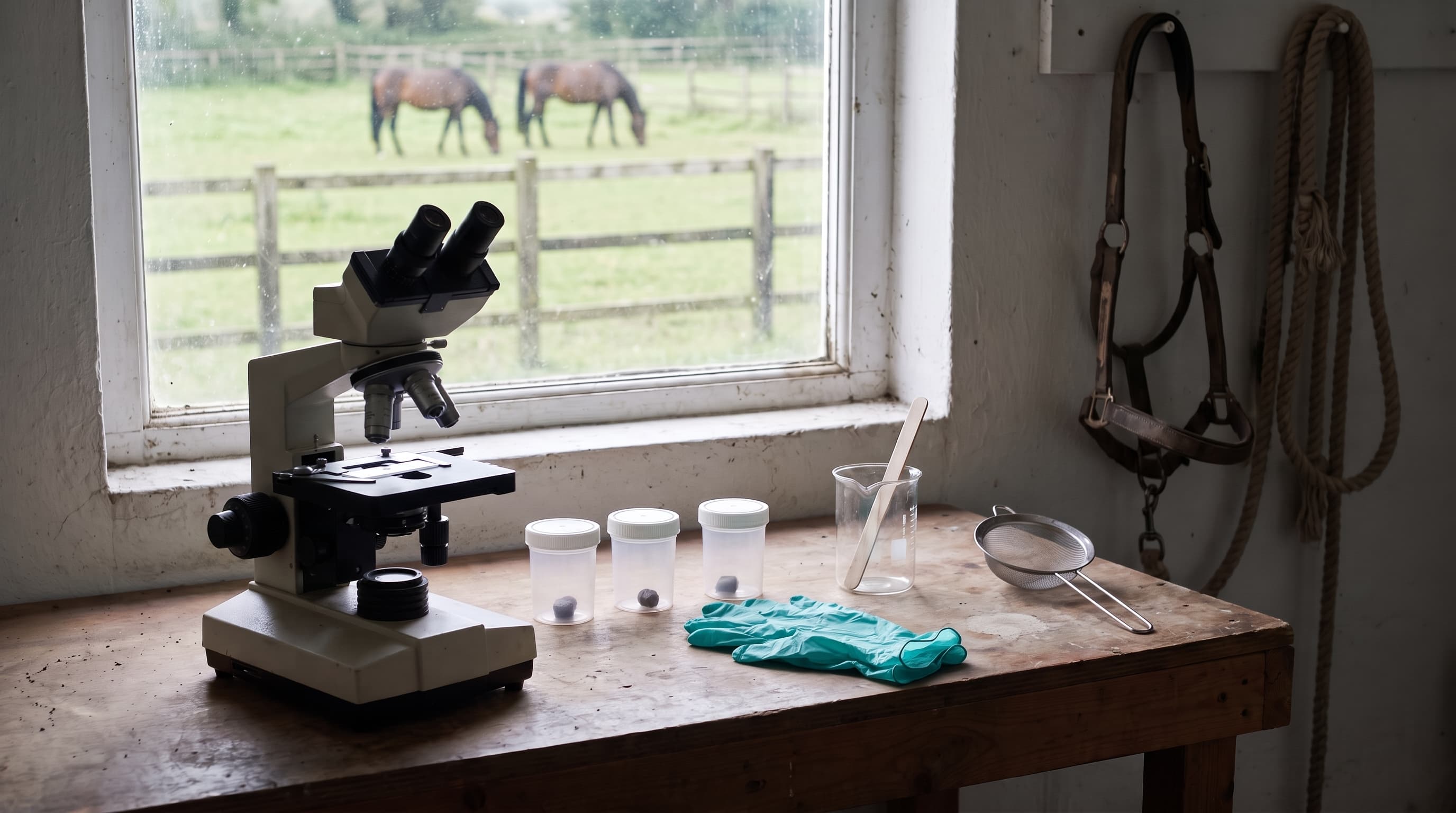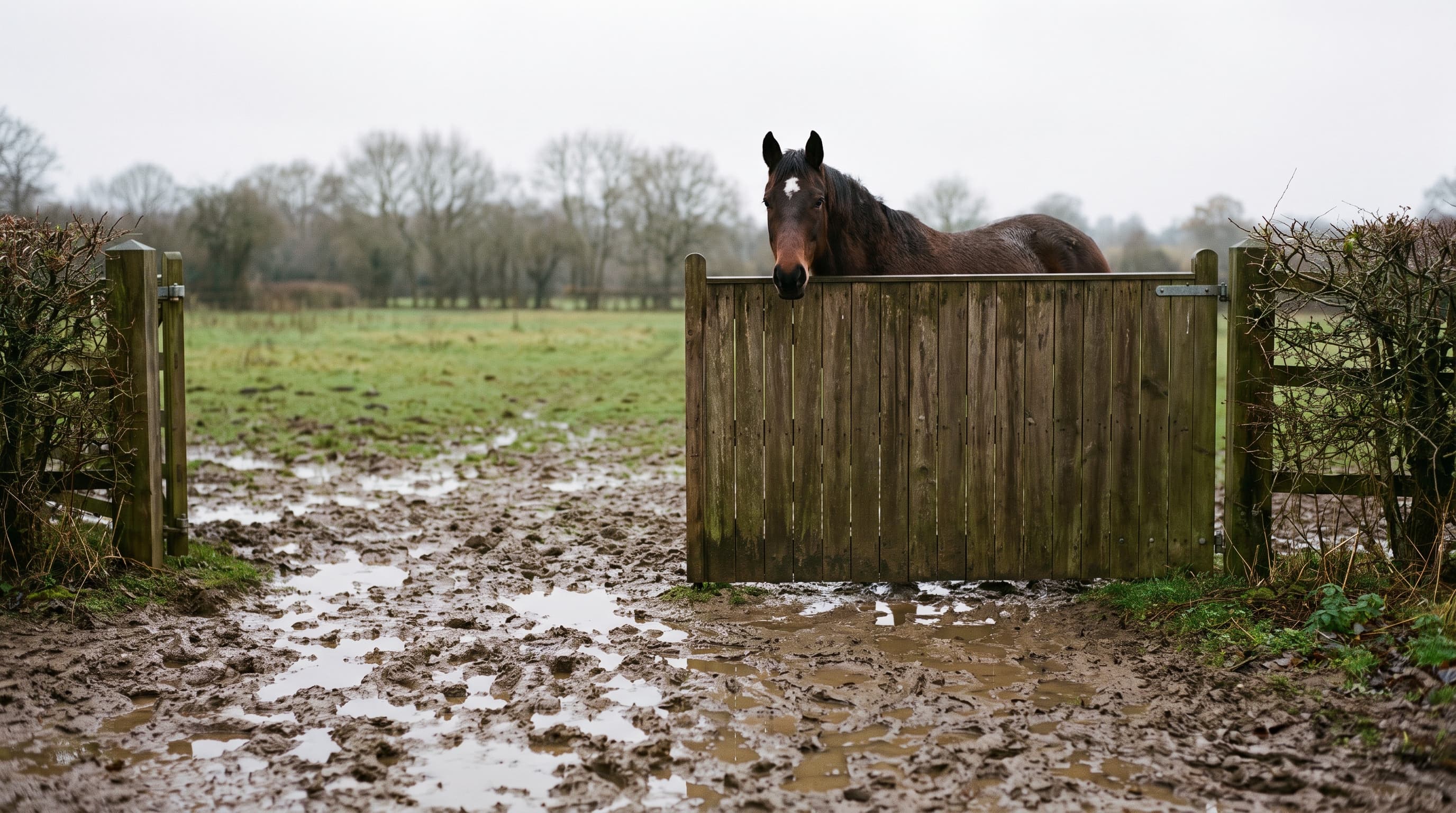
It has rained for a fortnight, the gateway is a bog, and when you pick up a hind foot there is a crust of scabs in the back of the white pastern, with damp, matted hair underneath. Everyone on the yard has the same word for it and a different tub of cream. Before you buy one, it helps to know what mud fever in horses actually is, because the answer changes what you put on that leg.
This is for the owner facing a first wet winter. It covers what sits behind the scabs, why the shop remedies so often fail, when the leg needs a vet rather than a cream, and how to keep it away without scrubbing the legs raw. It is not veterinary advice: the diagnosis and anything on prescription belong to your vet.
Mud fever in horses is a pattern, not one disease
Vets call it pastern dermatitis. In the US it is mostly searched for as scratches in horses, and greasy heel and cracked heels are other names for the same thing. Purdue University's vet school lists all of them and describes it as a mixed bacterial, often fungal and sometimes parasitic skin condition of the heel, the back of the pastern and the fetlock.
The specialists go further. A 2013 review for equine vets says pastern dermatitis is not a single disease but a reaction pattern of the skin, a syndrome rather than a diagnosis, and that finding the underlying cause before treating is the key to avoiding treatment failure. A 2023 review in the Journal of the American Veterinary Medical Association agrees, and adds that therapy remains largely empirical because good original studies are still scarce. The scabs look much the same whatever caused them. The cause is what decides the treatment.
What can sit behind the scabs
| Cause | Which horses | What it needs |
|---|---|---|
| Bacteria in skin softened by wet and mud | Any horse, worst in wet spells | Dry legs, gentle cleaning, your vet's choice of treatment |
| Chorioptes leg mites | Heavily feathered horses, draught breeds above all | Its own mite treatment, from your vet |
| Pastern vasculitis | Mostly white legs | A biopsy to diagnose it, protection from sunlight, prescription drugs |
| Photosensitisation | White skin, often after grazing a plant that harms the liver | A vet, liver tests, and shade or stabling by day |
Bacteria
Wet skin softens, mud rubs it, and bacteria get in; the British Horse Society lists standing in muddy or wet conditions for long periods among the risk factors. Which bacteria is less settled than the shop leaflets suggest. In a Munich study that examined 100 young warmbloods every week from August to October over two autumns, 33 developed pastern lesions; staphylococci and streptococci were cultured from 10 of 12 sampled cases, and the bacterium usually named as the cause, Dermatophilus congolensis, was not found in any of the 10 horses tested for it.
Mites
In feathered horses, the itch of Chorioptes mites makes them stamp and break their own skin. A controlled trial in 19 heavily feathered horses calls the mite a common cause of pastern dermatitis, notes that treatment failure and relapse are common, and found that the regime it tested did not clear the mites. That is a job for your vet.
White legs and sunlight
In the Munich horses, 37 of the 47 affected legs were unpigmented. Some white-legged horses have pastern vasculitis, an inflammation of small blood vessels that sunlight is suspected of making worse. The University of Guelph's diagnostic laboratory says it is diagnosed from a skin biopsy, and a series of 20 cases found the response to treatment poor and the prognosis guarded. Photosensitisation is a different problem with a similar look: the Merck Veterinary Manual explains that in horses it is most often linked to the liver, and a common cause is grazing plants that damage the liver, so the skin is the sign and the liver is the problem.
Fungus
Fungus is the one cause the evidence is weakest for. The 2023 review found associations with mites and with disturbed skin bacteria, but not with fungal infection.
Why the cream on the shelf so often fails
Search for mud fever in horses in Britain and most of the first page is retailers and feed companies, each with a routine that assumes one cause. A soothing cream does nothing about mites, a vasculitis or a damaged liver, and each of those needs its own treatment. A survey of the owners of 123 affected horses, published in a Swiss veterinary journal, found that 69% of treatment decisions were made without a vet, and that for about a third of the horses the vet was called only once the horse was in pain or lame. The authors' point is that this makes the underlying cause harder to find and the treatment longer.
There is also a reason for caution with antibacterials bought over the counter. A Swiss study of the skin bacteria on 80 horses found staphylococci increased in the lesions, particularly where antibacterial treatment had already been used. That does not prove the creams caused it, but it is one more reason to let the vet decide what goes on the leg.
When mud fever needs the vet
The BHS advises calling your vet as soon as mud fever is suspected, so the treatment fits the cause. At the very least, call when you see any of these:
- Lameness, or a horse that will not let you touch the leg.
- Swelling that spreads up the leg, or heat in it. Untreated pastern dermatitis can lead to cellulitis and lymphangitis, infections that often affect one leg at a time.
- Deep wounds, or a white or yellow discharge, which Purdue lists as reasons to call.
- Scabs on white legs of a horse at grass, especially with sore skin elsewhere on white or pink areas, which points away from mud and towards vasculitis or photosensitisation.
- A case that is not getting better on the routine you started, or that keeps coming back.
If your horse has Cushing's disease or another illness that weakens the immune system, tell the vet: the BHS notes these horses get mud fever more easily and are harder to treat. Your vet may take a swab, a blood test or a biopsy, and those tests are how the cause gets named.
What helps while you wait for the vet
Get the horse onto dry ground. Purdue's vets say the main thing that allows healing is a clean, dry environment, which may mean a stable with clean, dry bedding for a while. Do not pick or pull the scabs; Purdue's rule of thumb is "don't scratch scratches", and the BHS says scabs should not be forcibly removed unless your vet advises it.
If the vet asks you to wash the leg, use warm water, rinse thoroughly and pat it completely dry with a clean towel. Keep thick, oily ointments and barrier creams off broken skin: World Horse Welfare warns that these bacteria like airless conditions, and the BHS says a barrier cream on dirty or damp skin gives them the perfect place to grow.
Preventing mud fever without over-washing
The instinct is to hose every leg clean each evening. The BHS lists regular washing, especially without drying afterwards, as a risk factor in its own right, and advises letting the mud dry and brushing it off instead. The rest of the advice is about ground and kit:
- Give the horse somewhere dry to stand for part of every day, and put hard standing in gateways and round water troughs.
- Use a barrier cream before turnout only on clean, dry, unbroken skin.
- If you use turnout boots, make sure they fit; Purdue adds that wraps which hold moisture against the leg make things worse, and that boots should not be shared between horses.
- Look at the back of every pastern each day. Early cases are the easy ones.
Feathered horses are the hard case. Clipping the feathers lets the skin dry and lets you see it, and both Purdue and the BHS suggest it where the hair traps moisture, but mites still need their own treatment. In the Munich study most of the lesions healed once the horses stopped going out on pasture in November, which fits everything else here: the ground matters more than the tub.
Where we fit
Hoofine cannot diagnose a leg, and no article can. What the site can do is help you find equine vets and livery yards near you, so you can ask about turnout and dry standing before the ground turns. If you are buying a feathered horse, ask about its legs at the pre-purchase vetting, and read when to rug a horse for the rest of the first winter.