Two adverts on the same screen: one gelding is 16.2 hh, the other is 168 cm, and a third, from a German breeder, says 172 cm. They could be the same size, or several centimetres apart, and the adverts alone will not tell you which. Before you compare them, or write your own, it helps to know how to measure a horse the way the rulebooks do, and what each of those numbers actually says.
This is for the seller putting a height in an advert and the buyer reading one. It covers what a hand is, a conversion table worked out exactly, where the stick goes, why a tape gives a bigger number, what shoes do, and where the pony line really sits.
How many hands is a horse, and what the ".2" means
A hand is 4 inches, and an inch is exactly 2.54 cm, according to the US National Institute of Standards and Technology's unit tables. So one hand is exactly 10.16 cm. When people ask how many hands is a horse, the honest answer is a range, but the unit itself never changes.
The figure after the point is not a decimal. It counts the inches left over, and it only runs from 0 to 3, because a fourth inch makes the next whole hand. So 15.2 hh is 15 hands and 2 inches: 15 × 4 + 2 = 62 inches, and 62 × 2.54 = 157.48 cm. Treat it as fifteen point two hands and you get 154.43 cm, three centimetres short. There is no such height as 15.4, and an advert that says 16.5 hh has been run through a calculator by someone who did not know this.
A horse height chart from hands to centimetres
Every figure below is the inches multiplied by 2.54, not rounded. Many published tables round to the nearest centimetre, which is fine for an advert and not fine at a pony limit. The Scottish Government's table, for example, uses 10.2 cm to the hand and prints 16 hands as 163 cm; exactly, it is 162.56.
| Hands | Inches | Centimetres |
|---|---|---|
| 12.2 | 50 | 127.00 |
| 13.2 | 54 | 137.16 |
| 14.0 | 56 | 142.24 |
| 14.2 | 58 | 147.32 |
| 14.3 | 59 | 149.86 |
| 15.0 | 60 | 152.40 |
| 15.1 | 61 | 154.94 |
| 15.2 | 62 | 157.48 |
| 15.3 | 63 | 160.02 |
| 16.0 | 64 | 162.56 |
| 16.1 | 65 | 165.10 |
| 16.2 | 66 | 167.64 |
| 16.3 | 67 | 170.18 |
| 17.0 | 68 | 172.72 |
| 17.2 | 70 | 177.80 |
| 18.0 | 72 | 182.88 |
Going the other way, divide the centimetres by 2.54 and split the inches into fours. The 168 cm gelding is 66.14 inches, a fraction over 16.2. So the first two adverts describe the same height to within half a centimetre. The third is the one to ask about.
How to measure a horse the way the officials do
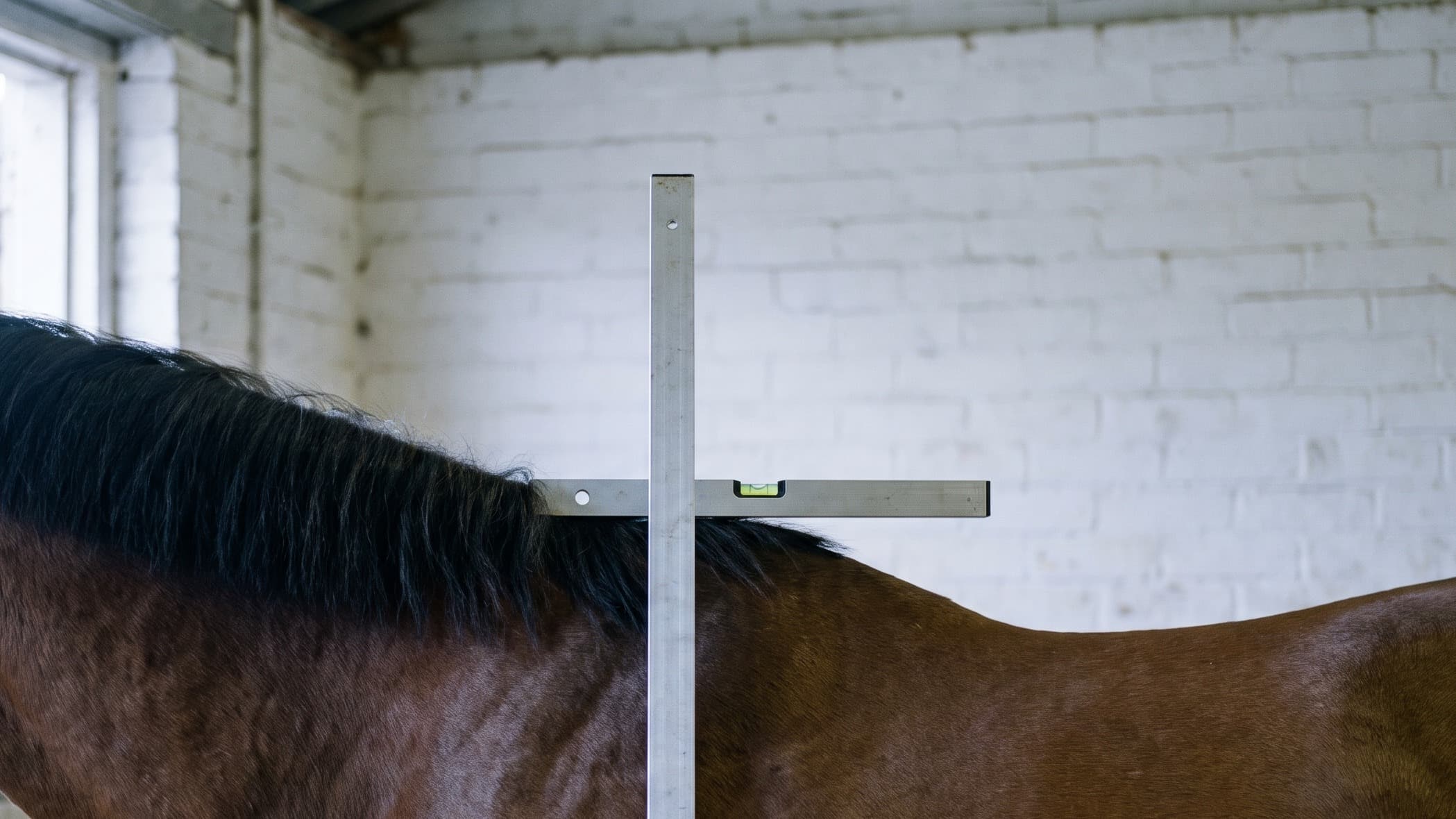
Every rulebook we read measures the same thing: the vertical distance from level ground to the highest point of the withers. The UK's Joint Measurement Board places that point immediately above the spine of the fifth thoracic vertebra. The French federation's rules add a practical trick: if the point is hard to find, have the horse lower its head first, find the top of the withers and mark it.
The ground matters as much as the stick. The Iowa State extension procedure asks for a smooth, level surface, preferably concrete or tarmac, the horse standing square with its weight even on all four feet, and its head relaxed in a natural position. A stretched or propped horse gives a false reading, and so does one measured straight after hard work. It also advises taking a reading from each side and averaging the two.
Use a rigid measuring stick with a spirit level in its arm, stand the upright vertical, and lower the arm until it rests on the withers without pressing. The JMB's rule is that the result is the horse's lowest truly relaxed height, and it limits how far the head may be raised or dropped while the stick is on. If you have no stick, you do not have a measurement. A tape held up the side of the shoulder is a guess.
Stick or tape: why German adverts can disagree by most of a hand
German adverts sometimes quote two heights. The Stockmaß is the stick measurement, straight up from the ground. The Bandmaß is taken with a tape laid along the body from just behind the foreleg to the withers, so it follows the curve of the body and reads more.
How much more was measured in a 2004 field study at the Munich veterinary faculty, which took both on the same animals. The warmblood mares averaged 163.4 cm by stick and 172.1 cm by tape, a difference of 8.7 cm, or most of a hand. The South German coldblood mares differed by 12.3 cm and the Knabstrupper ponies by 5.9 cm. Those are one study's averages, not a conversion factor, but they explain the third advert: 172 cm by tape and 168 cm by stick can be the same horse.
The official pony rules we read measure with the stick; the German federation says so in as many words. If an advert gives one number without saying which, ask. A seller who writes "172 cm" and means the tape will not enjoy the conversation at the viewing.
Shoes, and the centimetre that decides a pony
Shoes lift a horse off the ground, and the rulebooks deal with it in different ways.
| Rulebook | Pony limit or shoe rule |
|---|---|
| FEI (international) | 148 cm without shoes, 149 cm with |
| FN (Germany) | large ponies 138 to 148 cm, 149 cm shod |
| FFE (France) | 148 cm unshod; every height class 1 cm higher shod |
| KNHS (Netherlands) | height defined without shoes |
| JMB (UK) | all four shoes removed, no allowance |
| Iowa 4-H (US) | subtract a quarter of an inch if shod |
Under the FEI scheme as British Equestrian publishes it, two vets measure separately and the lower reading counts, and anything from 148.1 to 148.9 cm is rounded down to 148. The German federation's limits follow the same 148 and 149. When you measure at home, write down whether the horse was shod. It is the first thing a buyer with a pony in mind will ask.
The pony line is not the same line everywhere
In centimetre countries a pony is 148 cm or less. In US hunter classes it is 14.2 hh or less, and 14.2 hh is 147.32 cm. A pony that measures 147.8 cm is a pony at an FEI show and over the line at a US hunter show. Iowa's 4-H draws it lower still, at 14.1. "Pony" is whatever the rulebook in front of you says it is.
Young horses complicate it further. The JMB will not measure before the age of four, issues annual certificates from four to seven and a life certificate from eight. The FEI gives a lifetime certificate from eight. In Germany, large ponies measuring 142 cm or more at their first measurement need a new certificate every year up to the age of seven. A height given for a four-year-old is provisional, whoever measured it.
What to put in the advert, and what to ask
If you are selling, the height is one of the first things a buyer screens on, as covered in what a horse listing has to show. Give it in centimetres and hands, say it was measured by stick, say whether the horse was shod, and give the date if the horse is under eight. If you have an official certificate, say so; if you measured it yourself, say that too. A buyer forgives a horse being a little smaller than they hoped far more readily than an advert that rounded up.
If you are buying, ask which measurement it is, whether there is a certificate, and for a pony, which rulebook it was measured under. Bring your own stick to the viewing if the height matters, stand the horse on level concrete and measure it yourself. It settles the question before anyone has paid for a vetting.
Where we fit
Hoofine stores and shows every horse's height in centimetres, so enter the stick measurement in centimetres when you list, and give the hands and the shoeing in the description if your buyers think in hands. Buyers comparing the horses for sale then read every height on one scale, and on the Wanted board they can post the height range they are looking for. The site does not measure horses and cannot tell you whether a height in an advert is right; a stick on level ground can, and for a competition pony only an official measurement counts.