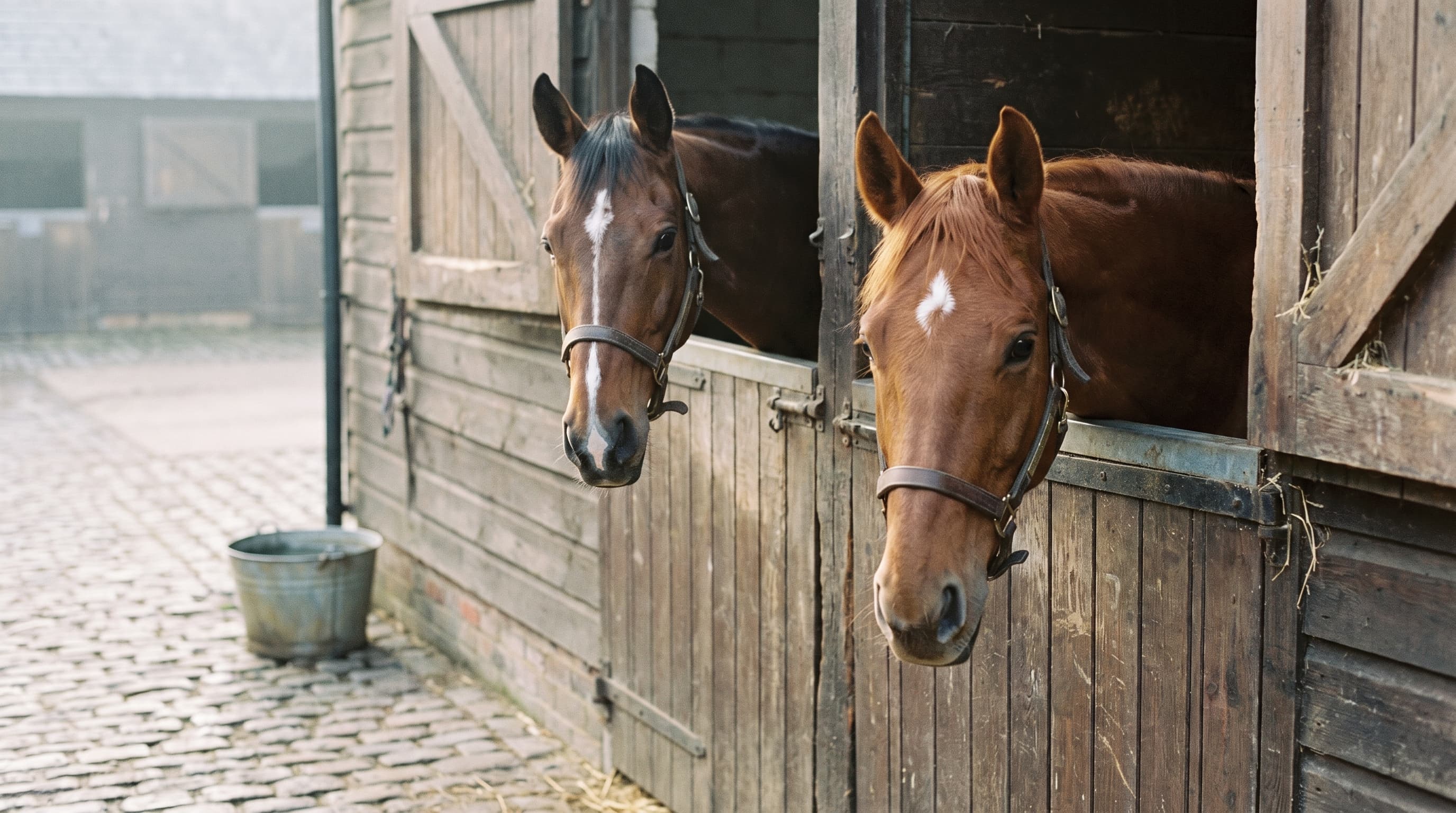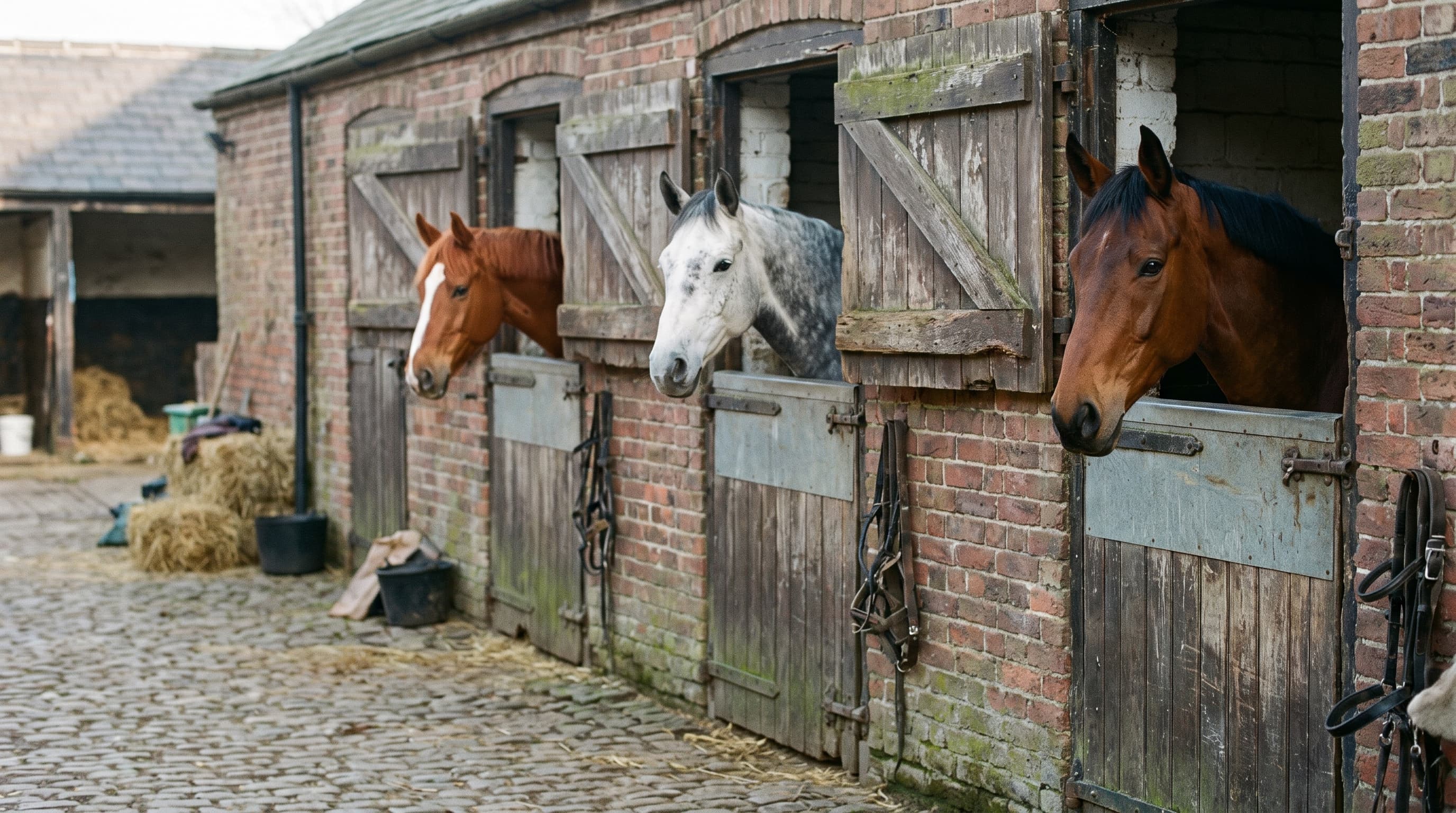
The advert says bay mare, the passport says brown, and the stallion you have in mind for her is chestnut. Whether those three words agree, and what colour foal the covering could give you, comes down to how horse coat colours are inherited and how they are written down, which are two different things.
This is for the buyer reading adverts and passports, and for the breeder wondering what a mating can produce: the genes behind the colours, the ones with health consequences, and what a DNA test settles that a description cannot.
Two genes make the three base horse coat colours
Under all the names there are three base colours, chestnut, bay and black, and two genes decide between them. The first, Extension, often called red factor, decides whether a horse can make black pigment at all. The Veterinary Genetics Laboratory at UC Davis explains that a horse with two copies of the recessive red allele makes no black pigment in its coat and passes a red allele to every foal. The second, Agouti, decides where the black goes. With the dominant allele it is restricted to the points, the mane, tail and lower legs, which is bay; with two recessive copies it spreads over the whole body, which is black.
| Extension | Agouti | Base colour |
|---|---|---|
| e/e | any | Chestnut: no black pigment |
| E/E or E/e | A/A or A/a | Bay: black on the points |
| E/E or E/e | a/a | Black: black all over |
Agouti only shows on a horse that can make black pigment, so a chestnut can carry the allele for black without anyone knowing. Two chestnuts can only produce chestnut-based foals, because neither has an E to pass on, and a horse with two copies of E will not produce a red foal whatever it is mated with. A bay or black parent's coat cannot tell you whether it hides a red allele.
Dilutions: cream, dun, silver and champagne
On top of the base colour sit the dilution genes, and each one works differently. Cream dilutes red pigment. One copy turns a chestnut into a palomino and a bay into a buckskin; two copies give a cremello or a perlino. On a black horse, UC Davis notes, one copy of cream has a very subtle effect, so a smoky black can be sold as black while passing cream to half its foals.
Dun lightens the body and leaves the head, lower legs, mane and tail undiluted, usually with a dark stripe along the spine and sometimes bars on the legs. Those primitive markings are not proof of dun: the laboratory's results show that a horse with one of the non-dun alleles may still have primitive markings without the dilution.
Silver acts only on black pigment, turning a black coat chocolate and the mane and tail flaxen or silver. On a chestnut it is invisible, and it matters beyond colour: the same mutation causes an inherited eye syndrome, multiple congenital ocular anomalies (MCOA), and UC Davis says a chestnut carrying silver is likely to have the eye changes even though its coat shows nothing. Champagne dilutes both pigments and gives pinkish skin and amber eyes.
Grey is a process, and it carries a melanoma risk
A grey horse is born another colour. UC Davis describes grey as progressive depigmentation that can act on any base colour and often leaves the coat almost completely white by six to twelve years old, with the first white hairs usually around the eyes. Grey is dominant, so one copy is enough. In practice that means a grey foal has at least one grey parent, and an adult horse that has not turned grey does not carry it hidden.
The same mutation predisposes grey horses to melanoma. UC Davis states that over 70% of grey horses older than 15 will develop it, commonly around the tail and head. In a clinical study of 296 grey Lipizzaners, half had dermal melanomas, and among the 68 horses older than 15, 51 had them. In 75.6% of cases the tumours were under the tail. The authors found them less malignant than melanomas in solid-coloured horses; none of the affected horses suffered severe clinical effects.
A 2024 study in Nature Communications found two versions of the grey mutation: one greys fast and carries a high incidence of melanoma, the other greys slowly with a low incidence, and a DNA test now tells them apart. For a buyer, a grey's age and the skin under its tail are part of the colour question. Whether a lump matters is for the vet at the pre-purchase vetting to judge, not the advert.
White patterns and the lethal white foal
White patterns are separate genes again. Tobiano, the pattern in which white crosses the back somewhere between the ears and the tail, is dominant, and a horse with two copies always produces tobiano foals. Frame overo is the pattern breeders have to test for. One copy of the mutation gives the pattern. Two copies give lethal white overo: the Center for Equine Health at UC Davis describes the foals as all white and born with an underdeveloped intestinal tract. There is no treatment; they die within a few days of birth or are put down. The cause, a change in a gene called EDNRB, was identified in 1998.
Each foal of two carriers has a 25% chance of being affected, and a carrier is not always visible: in the centre's words, horses thought to be solid coloured have produced affected foals, and the mutation has been found in Thoroughbreds, Quarter Horses, Appaloosas and American Miniature Horses as well as Paints. The American Paint Horse Association requires an OLWS result for every breeding stallion. If either parent could carry it, test both before the covering.
Horse markings and colour in the passport are a description
In the EU a horse must be identified within 12 months of birth. Its passport records the colour in words and draws its horse markings on an outline diagram: white patterns and scars in red ink, whorls in black. Regulation (EU) 2021/963 explains why: a microchip alone may not be enough to identify a horse, so the description and diagram back it up. It records what the person filling it in saw, often on a foal.
That is where horse coat colours and genotype part company. Japan's thoroughbred studbook warns that a grey foal may show only a few white hairs at birth and cannot always be judged grey straight away, and that a black coat can turn brown at the tips with the season and pass for a darker bay. The US Department of Agriculture's reference guide for vets says that there is no standardized nomenclature for describing equine colour and markings. Some studbooks write only the base colour unless a test proves more: the Dutch office of the Spanish PRE studbook explains that a perlino usually goes into the passport as chestnut, and that the colour can only be changed on the strength of a genetic test.
So read the colour in a passport as the name the horse was given, not a statement of what it carries. What matters is that the description and diagram match the horse in front of you; if they do not, ask why before going further.
What horse colour genetics can and cannot tell a breeder
A DNA test reads the genotype from 20 to 40 hairs pulled with their roots from the mane or tail. At UC Davis in October 2026 a single colour test cost $42 and its horse coat colour panel $85. Some studbooks accept only their own laboratory: the PRE studbook changes a passport colour only on a test done by its breed society, ANCCE.
For a breeder, horse colour genetics turns a guess into odds. Test the mare and the stallion for the genes that matter to the cross: red factor and agouti for the base colour, cream if either could hide it, grey if you want to know how fast a grey foal will whiten, frame overo if there is any white-patterned horse in either pedigree. The rest is arithmetic: a bay mare carrying red (E/e) put to a chestnut stallion (e/e) gives each foal a 50% chance of being chestnut. The colours recorded for the ancestors, which the pedigree lookup shows, are a starting point; only a test settles what the parents carry.
What a test cannot do is promise a particular foal; you wait out the pregnancy, covered in how long horses are pregnant, to see which way the odds fell. Nor does it say anything about soundness, temperament or ability.
Where we fit
On Hoofine the colour in a listing is what the seller typed, so treat it like the passport: a description to check against the horse. Owners can record a horse's OLWS result on its profile, and it is shown with who made the claim: the owner alone, the owner with a lab report attached, or a report we have checked against the horse. To plan a cross, start from the stallions on Hoofine; to buy, the horses for sale. Neither replaces the test.