The horse is paid for, the transport is booked, and then the seller mentions that the saddle is not part of the deal. How much does a saddle cost is the next question, and the honest first answer is that nobody publishes one: no trade body, regulator or survey in any country we checked collects saddle prices. What exists are individual makers' own lists and individual fitters' own fees.
This is for the first-time owner budgeting that purchase. It sets out the published prices we could find, what the money buys, what to check on a used saddle, what a fitting costs and who is qualified to do one. The order matters, because a saddle is bought for the horse first and the rider second.
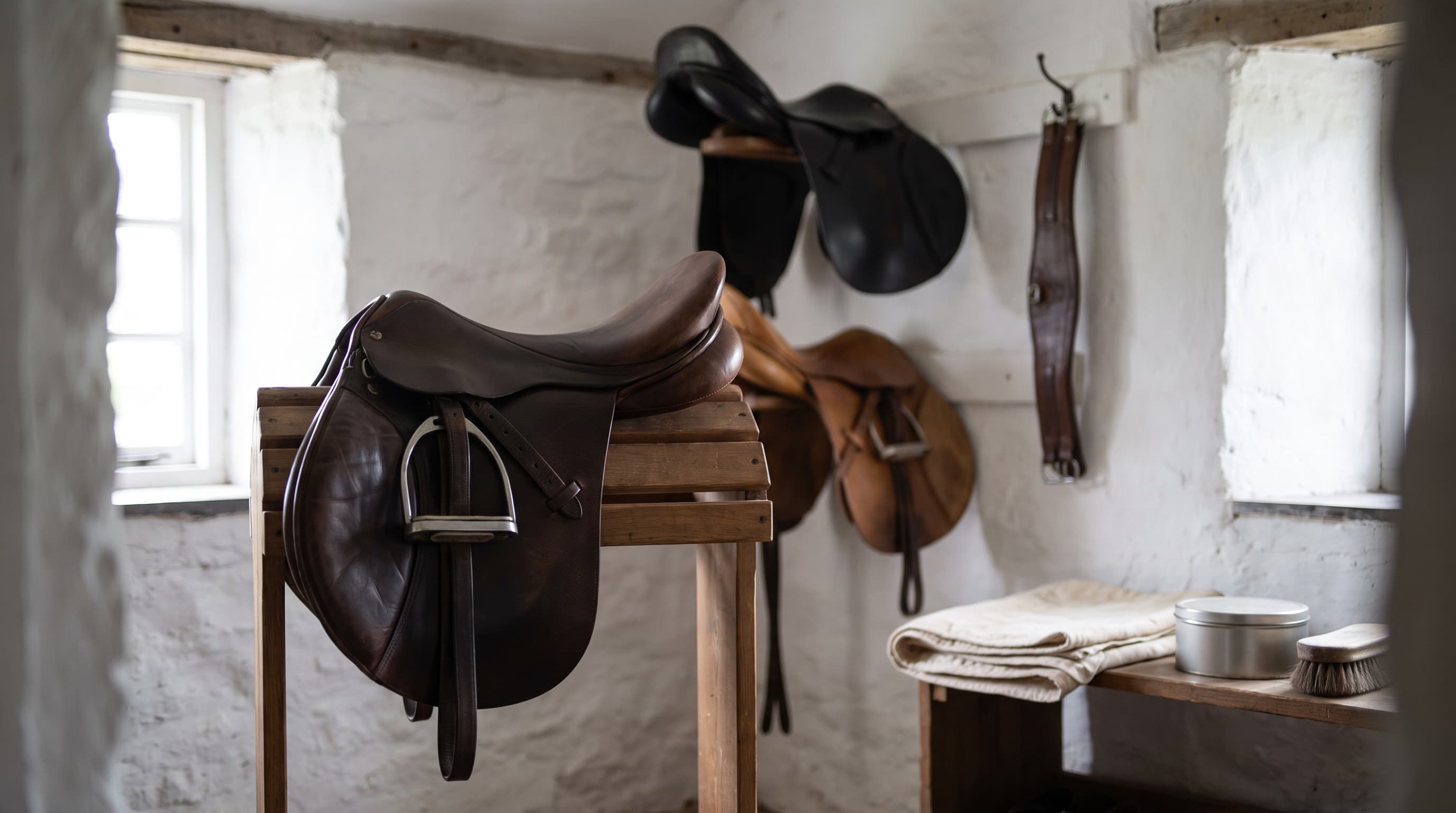
How much does a saddle cost on the makers' own lists
These are four makers' own published prices, read on 1 October 2026. Each is that maker's figure for that model, in its own currency. None of them is "the market".
| Maker and model | What it is | Listed price |
|---|---|---|
| Thorowgood T9 (general purpose, dressage, jump) | Off the peg, leather and synthetic, changeable gullet bar | £845 |
| Kieffer, Passion One to Cannes | Off the peg, German leather saddles | €1,300 to €3,300 |
| Synergist custom saddle | Made to measure, trail and endurance | $2,795 base, before options |
| Hermès, Cavale II to Faubourg | Made to measure, jumping | €7,500 to €8,500 |
Read the table for its shape, not its ends. The cheapest and dearest lines are not the limits of anything; they are four makers who happen to print their prices, and Synergist's page already carries a notice that its base price is rising to $2,995. Many makers of leather saddles print no prices at all, which is why a quote from a saddler is the only real answer for the saddle you have in mind.
How much is a horse saddle really buying you
Mostly a tree. Utah State University Extension calls it "the skeleton of the saddle", the part that supports the rider's weight and spreads it over the horse's back. That is measurable. In a 2012 study from Hilary Clayton's group, eight horses were ridden in a conventional saddle and a treeless one, and the treed saddle carried the rider over a larger area with lower mean and maximal pressures.
Width is the next thing you pay for. A study of 14 sports horses put each in a correctly fitted saddle, then in one a single width fitting wider and one narrower. In trot the wide saddle raised peak pressure under the front of the saddle by 8.5%, and the narrow one raised it under the back by 14%. The authors measured immediate effects only, so it shows that width matters, not what years in the wrong width do.
That is the case for a changeable gullet bar, which lets a fitter alter the width as the horse changes; Thorowgood lists its bars at £29.95. It is not a case for buying on width alone. Panel shape, length and balance have to suit the horse too, and Extension Horses, the US extension services' horse site, notes that no standards for gullet measurements exist across the industry. Leather, synthetic or a mix is a question of upkeep and budget: we found no study showing one is better for the horse. Made to measure buys a saddle built to one back as it is today, and backs change.
Used saddle prices and what to check first
No body publishes a guide to used saddle prices either, so the check matters more than the number. The Society of Master Saddlers' advice on buying second-hand, written with the British Horse Society, is to start with a saddlery or a qualified fitter, whose used stock will have been safety-checked, and if you buy privately to have a qualified saddler look the saddle over before you pay. It gives four checks.
- First impressions. Creases or ripples in the seat can be a sign of a weakened or broken tree.
- Wear. Look at the girth straps and the webs they hang from. Scuffs on the pommel and cantle can mean the saddle was dropped or damaged in a fall.
- The tree. Hold the saddle lengthwise with the pommel against your thigh, grip the cantle and pull it gently towards you. "A sound tree will flex a little, but an excessive amount of give suggests a broken tree."
- Stitching. Check for loose or rotting thread on the girth straps and D-rings.
A saddle with a damaged tree should not be used at all, the Society says, and Utah State's guide is blunter: a broken tree "can do serious damage to the horse's back". A sound used saddle still has to be fitted, because it has settled to the shape of another horse.
What a fitting costs
The Society's code of conduct expects members to tell you the cost of a fitting, travel included, before you commit, so ask. Two British saddlers publish theirs for 2026. TDS Saddlers in Hampshire charges £66 to £96 for a visit to one horse, depending on distance, and £144 for a full re-flock, which replaces the wool in the panels. Sarum Saddlery charges £75 for a saddle check and £170 for a full re-flock. In the United States two independent fitters, Saddles & Soles and Whole Horse Saddle Fit, each list $150 for a fitting, and the first lists $350 for a complete re-flock. Those are four businesses' prices, not a survey.
Who is qualified to fit a saddle
Legally, anyone. In Britain the Worshipful Company of Saddlers states that there is no statutory requirement for a person fitting a saddle to meet any standard of training or conduct, which is why it backs a voluntary register, the Equine Fitters Directory, launched in February 2025. The qualification to look for there is the Society of Master Saddlers' Qualified Saddle Fitter: at least three years of training and practice before the exam, a refresher course every two years and a code of conduct. The Society counts over 200 of them in the UK and 100 abroad.
We found no licensing scheme for saddle fitters in the United States either; the credentials on offer there are private ones, the Society's among them. Elsewhere the craft is trained but the fitting is not protected. Germany's saddler is a three-year recognised apprenticeship that includes fitting saddles, yet we found nothing in German trade law that reserves the title "saddle fitter", and we found no state qualification for saddle fitting in France. So ask what the person in front of you is qualified in, and by whom.
How often a saddle needs checking
Every six months, says the British Horse Society, because horses change shape with weight, fitness and muscle. The research agrees. Line Greve and Sue Dyson measured the backs of 104 sports horses every second month for a year, found "considerable variations in back dimensions", and concluded that fit should be reassessed professionally several times a year, especially after a change in work.
What a poor fit does is harder to pin down than a sales pitch suggests, and one finding cuts the other way. In the same authors' study of 506 horses the saddle slipped consistently to one side in 12.3% of them: in 24.4% of horses with hindlimb lameness against 5.5% of sound ones. A saddle that keeps sliding one way is a reason to call the vet as well as the fitter.
The saddle that comes with the horse
A saddle included in the sale is a reasonable place to start, because it has settled to this horse rather than another. It is still a used saddle with a history you do not know. Ask when it was last checked and by whom, run the four checks above, and book a fitter once the horse has settled in: the move, a new yard's feeding and your riding all change the back it sat on. If the seller mentions that the saddle slips, tell the vet doing the pre-purchase vetting.
Where we fit
Hoofine cannot fit a saddle, and a directory entry is not a qualification. What the tack shops and saddlers in the directory are there for is the questions above: what a visit costs with travel, what they are qualified in, and whether they will check a saddle you bought elsewhere. If the back is sore or the saddle slides, start with a vet. The saddle is one line in the budget set out in what a horse costs to buy, and its upkeep belongs in the monthly figure. If you are still choosing among horses for sale, ask each seller whether the saddle goes with the horse.