The wormer syringe is marked in kilograms, the vet has asked for your horse's weight, and the tape round his girth says 505. He is a big, deep-bodied gelding, and the tape may be thirty or forty kilos short. How much does a horse weigh has a range for an answer; how much yours weighs has a method, and the method is what this piece is about.
It is written for the owner who needs a real number for a dose, a feed ration or a trailer, and for the buyer who wants to know whether the weight in an advert was measured or guessed.
How much does a horse weigh on a weighbridge
Most answers give 400 to 600 kg for a riding horse and stop there, without saying who weighed anything. The largest weighed sample we could open is British: 1,716 horses over two years old, put on a weighbridge accurate to the nearest kilo during a feed company's nutrition visits and analysed with vets at the University of Edinburgh. The study, published in 2023, sorted them into four groups.
| Group | Average height | Average weight on the weighbridge |
|---|---|---|
| Small ponies (under 350 kg) | 115 cm | 255 kg |
| Large ponies (under 147 cm) | 139 cm | 436 kg |
| Lighter horse breeds | 162 cm | 545 kg |
| Stockier horse breeds | 155 cm | 545 kg |
The average horse weight across all 1,716 was 484 kg. Notice the last two rows: the stockier horses stood seven centimetres shorter and weighed the same, which is the first hint of why height alone tells you little. A Polish study that weighed 299 horses on an electronic scale found 501 kg for Thoroughbreds and between 561 and 588 kg for three Polish warmblood and Silesian breeds. We found no weighed average for heavy draught horses that we could open, so we will not print one.
Why the number matters
Three things you do depend on it. The first is the dose of any wormer or medicine, which your vet decides; the weight you give them is the part you control. Europe's parasite guideline, ESCCAP, names underdosing as one of the most relevant causes of wormer resistance, so a horse dosed for 505 kg when he weighs 545 gets less than the label intends. The deworming schedule is a separate question, and also your vet's.
The second is feed. Rations are worked out as a percentage of bodyweight, commonly 2% a day, as the hay article sets out. For the lighter horses above, 2% of the weighed 545 kg is 10.9 kg; 2% of the tape's average reading for the same horses, 505 kg, is 10.1 kg. That is 0.8 kg a day, or 144 kg over a 180-day winter.
The third is the trailer. In Britain, GOV.UK's towing guidance works from the maximum authorised mass shown on the trailer's plate, and a licence issued since 1997 covers a trailer up to 3,500 kg of it. The trailer's own weight, the horses and the kit all count. Other countries set their own rules, so check yours and read the plate, then do the sum with a measured weight. The transport cost guide covers the rest of a move.
A weighbridge is the only measurement
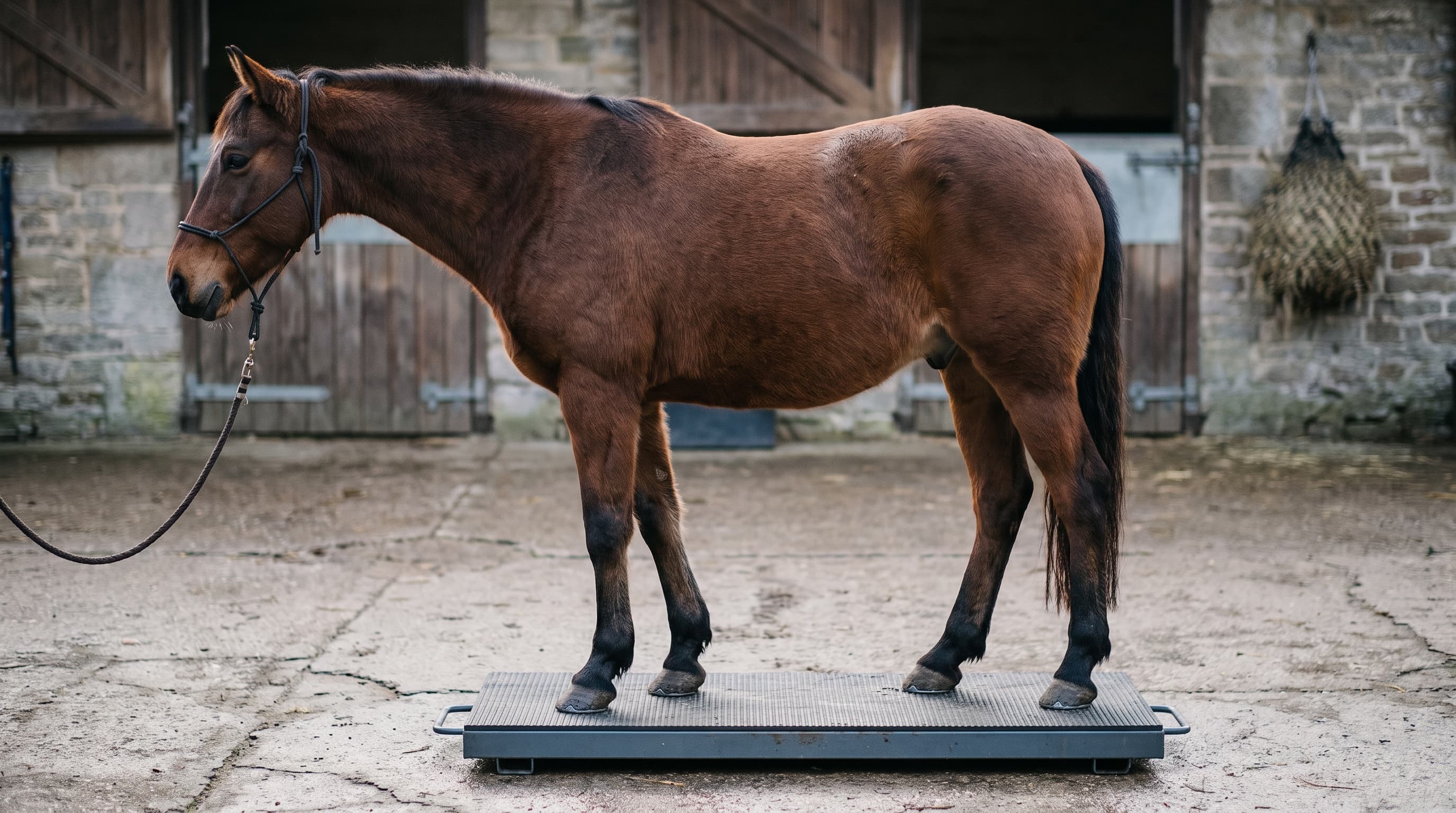
The American Association of Equine Practitioners calls electronic scales the most accurate method, and the British study above says the same of a weighbridge while noting they are rarely to hand because of the cost. Its own data came from portable weighbridges brought to yards. Ask your vet practice, your feed merchant or your yard whether they have one or can borrow one. Weigh without a rug, and if you can, at the same time of day each time.
The girth and length formula, and how far it is out
Without a weighbridge, the best estimate you can make at home comes from a 1988 paper in which Carroll and Huntington weighed 372 horses and found weight tracked girth squared times length very closely. The version used in the US divides by 11,880; the original paper's own figure, which the German federation FN uses, was 11,900. On a 500 kg horse the difference is under a kilo.
- Measure the girth right behind the elbow and straight up over the withers, in centimetres.
- Measure the length from the point of the shoulder to the point of the buttock.
- Weight in kg = girth × girth × length ÷ 11,880.
A horse with a 190 cm girth and a 160 cm length works out as 190 × 190 = 36,100, × 160 = 5,776,000, ÷ 11,880 = 486 kg. It is written for adult horses; a foal or a mare in foal is your vet's estimate.
How good is it? In a 2011 comparison of 145 horses on a scale, the formula was out by 17 kg on average when length was taken to the point of the buttock, against 66 kg for a commercial tape. In the Polish study it read low for every breed group, by 29 to 39 kg for the three warmblood and Silesian breeds and by 12 kg for the Thoroughbreds. Treat its answer as within a few per cent on average, wider for an individual horse, and usually on the light side for a well-built horse. Newer equations that add neck and height measurements do better, but they need four measurements and a breed type.
Why the horse weight tape reads low
A horse weight tape converts one measurement, the girth, into kilograms using its maker's formula. In the British study the tape read 33 kg below the weighbridge on average, with individual horses anywhere from 151 kg under to 64 kg over. It read slightly high on small ponies (+3.8%) and low on everything else: 6% under on large ponies, 7.1% on the lighter horse breeds and 8.5% on the stockier ones.
The authors' explanation is simple: the tape measures girth only, so a longer body or a heavier build is not counted. Their conclusion is that a weigh tape "cannot be relied upon to provide an accurate measurement of body weight". Tapes also disagree with each other. In a 1998 study of 600 horses, one brand averaged 112% of weighbridge weight and another 98% on the same animals. Guessing by eye did worse still, at 88% on average and widely scattered.
Tracking weight through the winter
For watching change, consistency matters more than accuracy. Use the same tape or the same formula, the same person, the same spot of level ground and the same time of day, rug off, and write the figure down with the date. Read the figure as a trend, not a true weight. One small study of six horses weighed weekly for nine weeks found the tape varied less from week to week than the formula did, though it was only six horses.
Expect some change. In a study of 96 British leisure horses living out, the share that were obese rose from 27% at the end of winter to 35% in summer: coming out of winter a little lighter is the normal pattern, and a good-doer that loses nothing has missed the chance to shed summer fat. In another small study, ponies of normal condition given unlimited feed kept gaining weight through the winter. A horse that drops weight fast, or keeps losing on a sensible ration, needs one of the equine vets, not more feed.
Where we fit
Hoofine cannot weigh your horse. If you are buying through a listing on horses for sale, ask the seller whether the weight in the advert came off a weighbridge, a tape or a guess, and when; then measure girth and length yourself at the viewing and do the sum. If you are selling, a dated weighbridge figure is worth putting in the advert, because it answers a question a careful buyer will otherwise ask.