The yard manager pins a sheet to the tack-room door: worming week, every horse, same tube. Or you have just bought a horse whose papers say nothing about when it was last wormed. Either way you are being asked to follow a horse deworming schedule without knowing whether it is a sensible one, and a printed calendar is often older than the advice vets now work to.
This is for the first-time owner in that position. It sets out what the current veterinary guidelines say, what a worm egg count can and cannot show, who may sell you a wormer where you live, and what to ask your vet. It is not a treatment plan: which product, how much and when are your vet's decisions. British yards call the same thing a horse worming schedule, and the science is identical.
How often should you deworm a horse? Not by the calendar
For decades the answer was every eight weeks or so, with a different product each time. The American Association of Equine Practitioners now tells vets the opposite. Its Internal Parasite Control Guidelines, revised in 2024, say to stop deworming all horses at fixed intervals year-round, giving "every 2 months" as the example, and to stop blindly rotating between drug classes. The British Equine Veterinary Association is blunter: interval deworming "is no longer an acceptable way to deworm mature horses".
The reason is resistance. Worms that survive a dose breed, and the more often a yard doses, the faster the survivors take over. The AAEP notes that no new class of wormer has been introduced for horses in 40 years and that none is expected. It tells vets to assume that small redworm, which every grazing horse carries, resists two of the three drug classes used against it until a test on that yard proves otherwise. The drugs that still work do so for less time: eight to sixteen weeks of low egg counts in the 1990s, depending on the drug, and four to five in studies since 2017.
What a horse deworming schedule looks like now
A 2025 review by the authors of seven national and European guidelines found that a modern horse deworming schedule has the same three parts everywhere: test first, treat the horses that need it, and check that the treatment worked. The details differ.
| Guideline | Testing | When an adult horse is treated |
|---|---|---|
| AAEP, United States (2024) | Egg counts once or twice a year | Every horse once or twice a year as a baseline; high shedders, above 500 eggs per gram, once or twice more while worms are being passed on at pasture |
| CANTER, United Kingdom (2026) | Egg counts one to four times a year; two in the grazing season is the suggested start | Above a threshold the prescriber sets between 200 and 500 eggs per gram, according to risk |
| ESCCAP, Europe (2019) | At least four egg counts in the first year, three in later years | Above 200 eggs per gram, or by a seasonal plan tied to faecal monitoring |
The logic is that worms are not shared out evenly. The AAEP describes a 20/80 rule: a fifth of the horses in a herd, or fewer, shed 80% of the eggs, and an adult horse tends to stay a high or a low shedder from one year to the next. Find the high shedders and the rest need far fewer doses.
Fewer is not none. The AAEP keeps a baseline treatment for every horse, and the review explains why: large redworm, the most dangerous of the worms, has re-emerged in Denmark and Sweden, where the rules on treatment are tightest. The ESCCAP guideline keeps a year-end treatment for horses that had none during the season.
None of this applies to foals and youngsters. The AAEP says egg-count-led treatment is not recommended in young horses, the UK guidelines class every horse under five as high risk, and ESCCAP says the old habit of dosing foals every four to eight weeks is no longer considered appropriate. Their plan is age-based, and the vet writes it.
What a worm egg count cannot see
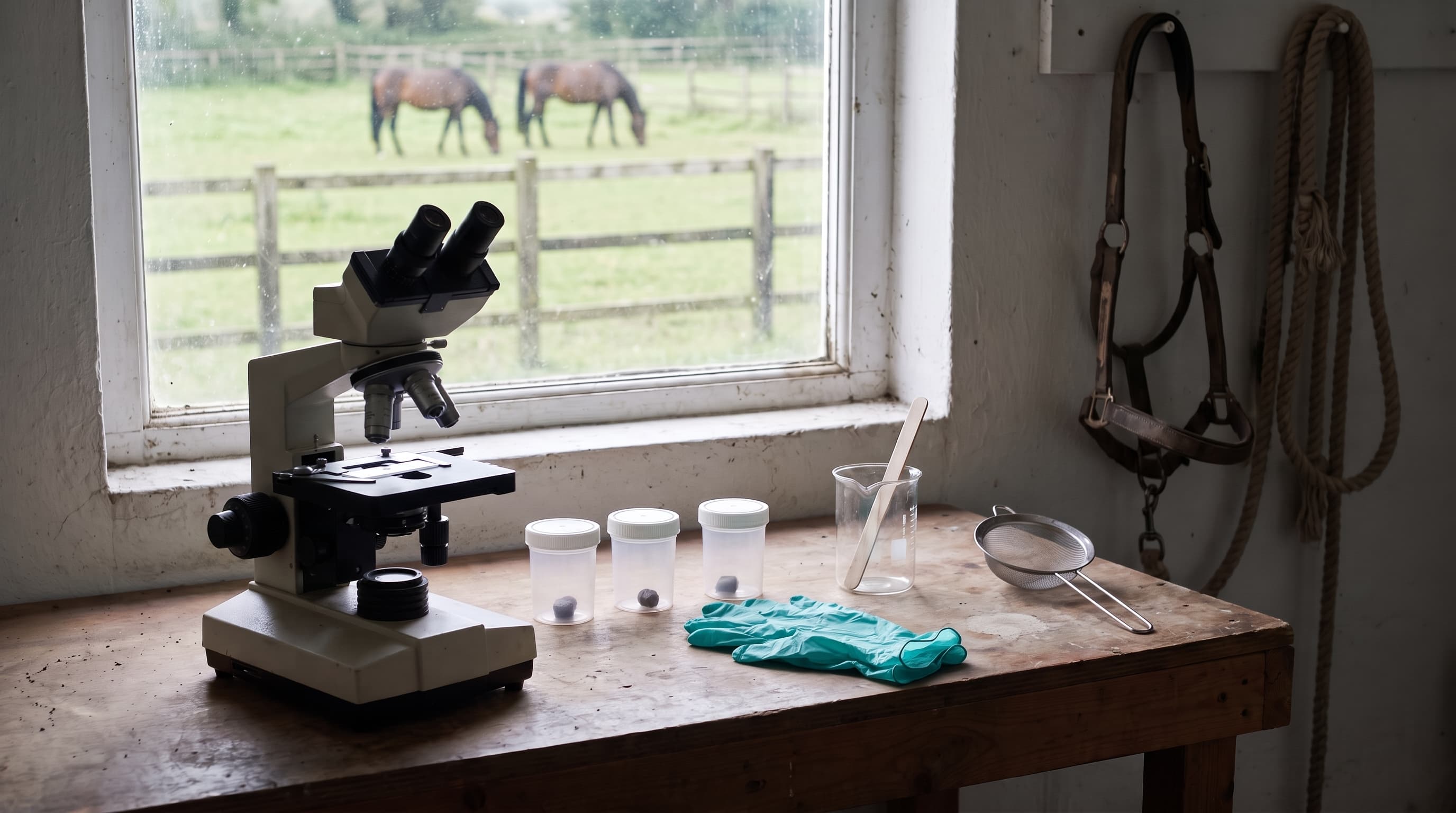
A faecal egg count, or worm egg count in Britain, estimates how many redworm eggs a horse is putting on to the pasture. That is all it measures. The AAEP is explicit that the size of the count does not correlate with the number of worms inside the horse and must not be used to diagnose illness. It also misses three things: tapeworm, which the standard method picks up less than 10% of the time; pinworm, whose eggs are stuck to the skin under the tail rather than passed in the dung; and the small redworm larvae encysted in the gut wall.
Those gaps are where a calendar adds an automatic autumn or winter dose, and where the guidelines differ from the calendar and from each other. For tapeworm, the AAEP advises one treatment a year for horses on green pasture and more only on evidence of infection. The CANTER guidelines in the UK prefer a saliva or blood antibody test and treating the horses that score above the threshold, a test the review says is sold commercially only in the UK.
For encysted redworm, the AAEP says there are no data showing a clinical benefit from routine treatment and that the disease is extremely rare in North America. CANTER says routine treatment is not considered necessary in well-managed, low-risk adult horses and should be considered for young and higher-risk ones. The disease is seen more regularly in northern Europe. This is a judgement about your horse and your yard, not a date in the diary.
Checking that the wormer still works
Every guideline insists on one more step, and it is the easiest to leave out. A faecal egg count reduction test compares a count taken before treatment with one taken 14 days after. The AAEP's rule of thumb is a fall of more than 95%, and it wants the test done every year in every barn.
Who can sell you a wormer depends on the country
In the United States equine dewormers are sold over the counter. In the UK they are prescription-only medicines in a category called POM-VPS: a vet, a pharmacist or a suitably qualified person may prescribe one, and under the Veterinary Medicines Directorate's rules must know enough about the horse to choose the right product. Expect questions.
In the European Union, Article 34 of Regulation (EU) 2019/6 makes medicines for food-producing animals prescription-only unless a product is specifically exempted, and one condition for exemption is that misuse carries no risk of resistance. Horses count as food-producing animals. Germany's federal regulator says horse wormers may be supplied only after a vet's diagnosis, and the Dutch food safety authority that they may be sold only against a vet's prescription. Denmark and Sweden go furthest and require diagnostic work to justify one.
The passport matters too. In the EU a horse is treated as destined for the food chain unless its passport has been signed to exclude it, permanently, and the UK works the same way. A wormer's leaflet says whether it may be given to a food-chain horse and how long the withdrawal period is, so the prescriber may ask to see the passport. The UK rules tell prescribers to treat an unsigned declaration as "intended for human consumption".
A new horse with no worming history
If you are buying, ask the seller for the worming and test records when you book the pre-purchase vetting. If there are none, say so to your vet. CANTER advises that a new arrival without a reliable history is tested and regarded as moderate or high risk, kept off the pasture until the risk of contaminating it has been dealt with, and quarantined for at least 21 days. Your new yard will have its own horse deworming schedule. Ask what it is based on before the lorry arrives.
What to ask your vet
- When should this horse have its egg counts, and at what count would you treat?
- Has anyone run a reduction test here to see which wormers still work on this yard?
- How do you want to handle tapeworm and encysted redworm for a horse of this age and history?
- What does the passport say about the food chain, and does it change what you can prescribe?
And one for the yard manager: how often are the fields cleared? ESCCAP advises removing droppings daily if possible and at least twice a week, and BEVA calls management of this kind, not medicine, the mainstay of worm control.
Where we fit
Hoofine cannot test a dung sample or prescribe anything. What it can do is put the people who can in one place. The equine vets in the directory are the ones to take those questions to, and the livery and boarding yards are worth asking about their worming policy before you move in. Egg counts and treatment are one line in the yearly budget that how much a horse costs per month sets out.