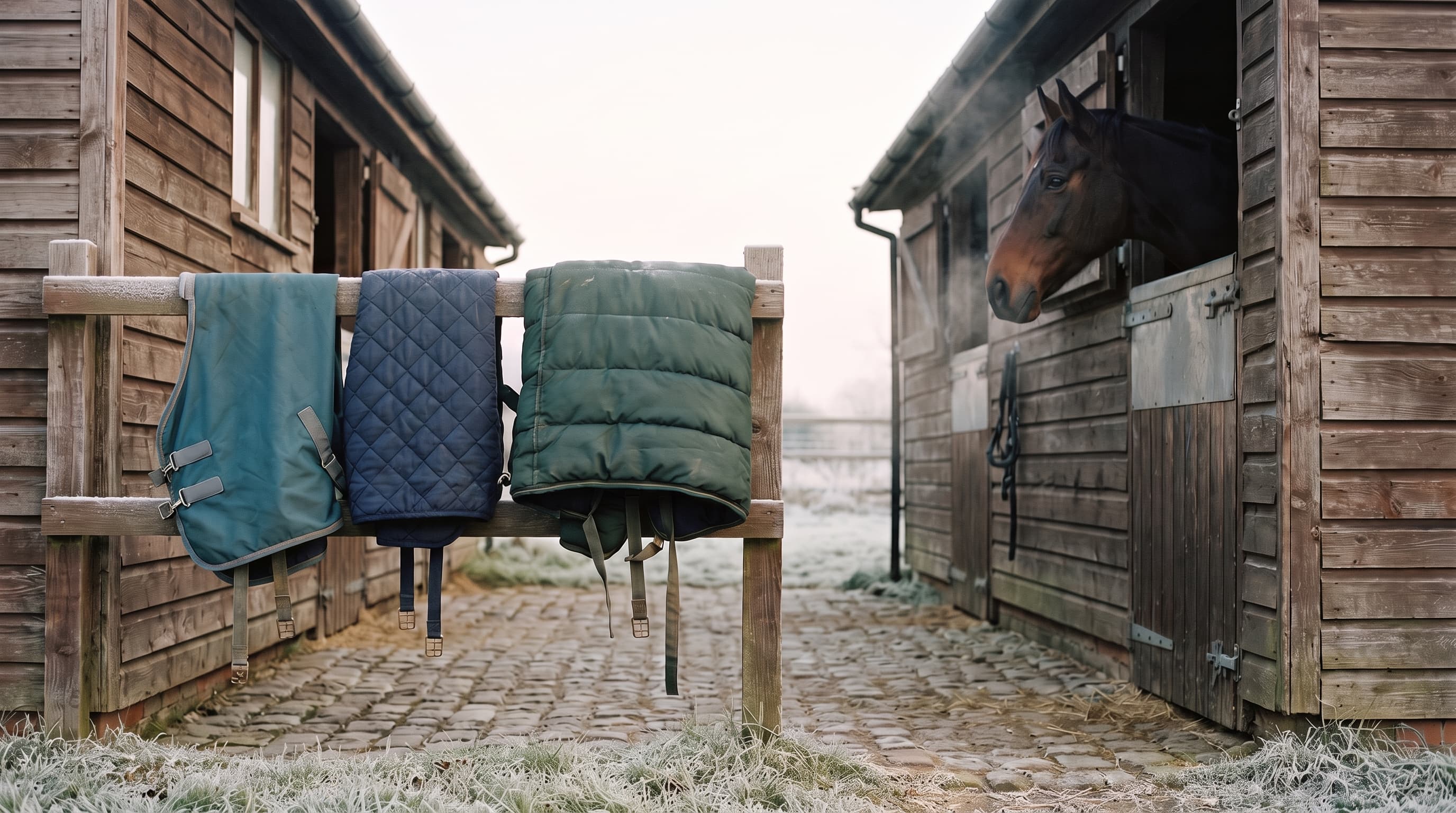
The first cold night of October arrives, half the yard is already wearing a medium-weight, and you are standing at the stable door with a rug over your arm, wondering whether your horse is the only one about to freeze. When to blanket a horse, or when to rug a horse if you learned to ride in Britain, is decided far less by the thermometer than by the horse in front of you: its coat, its age, its condition, the shelter it has, and whether it is wet.
This is for the first-time owner in their first autumn. It covers how much cold a horse really tolerates, what horses chose when researchers taught them to ask, which horses do need a rug, what the temperature charts leave out, and why putting on too much is a mistake of its own.
Your horse is not cold just because you are
France's national horse institute, the IFCE, puts the difference plainly in its fact sheet on how horses adapt to the cold. A clothed person is comfortable between about 18 and 24°C. An unclipped horse in a temperate climate is comfortable between roughly 5 and 25°C, and the temperature below which a healthy adult horse needs help, in the form of more feed and a shelter, is around -15°C.
You will see other figures, and the reason is worth knowing. University of Minnesota Extension gives 41°F (5°C) for a horse in its summer coat and 18°F (about -8°C) in its winter coat. A 2020 review by Norwegian researchers explains why the numbers move: this lower critical temperature is not a fixed value, it depends on age, breed, coat, feeding, body condition and what the horse is used to, and each figure holds only for the horses it was measured on. One study found 5°C in trotters kept at 15 to 20°C, another -15°C in Quarter Horses acclimatised to winter.
Wet and wind matter more than the thermometer
The same Norwegian group taught 23 horses to touch one of three boards to say "rug on", "rug off" or "no change", then asked them in all weathers. As the review reports the results, below -10°C the horses chose to wear a rug in 80 to 90% of tests. Above 20°C every horse tested wanted it off. At 10°C in fair weather only 5% of the horses without a rug asked for one. On a day of 6°C with rain and a strong wind, every horse tested asked for a rug.
That pattern runs through the rest of the evidence. In a herd of acclimatised Icelandic horses wintering out, with a shelter to go to, at temperatures down to -30°C, the review records shivering only once, on a day of 5°C with heavy rain. Minnesota's winter care guide notes that as little as 0.1 inch of rain, about 2.5 mm, can cause cold stress by matting the coat. A dry winter coat traps air. A soaked one does not.
So the first question on a cold evening is not the temperature but whether the horse can get out of the rain and wind. The reviewers call a shelter a more flexible answer than a rug, because the horse uses it when it chooses, and a rug a useful supplement in bad weather.
When to blanket a horse: the ones that do need a rug
Minnesota Extension lists the cases in which a blanket is needed, and the list is about the horse, not the date:
- there is no shelter at turnout and the temperature or wind chill falls below 5°F (-15°C)
- the horse is likely to get wet from rain, ice or freezing rain, which snow usually does not do
- its winter coat has been clipped
- it is very young or very old
- it is not acclimatised to the cold
- its body condition score is three or less
England's official welfare code says much the same in other words: many hardy breeds live out all year without rugs and often do better without them, while horses of less hardy breeding, and clipped or elderly ones, may need a rug to stay warm and dry in cold, wet weather. The British Horse Society adds finer-coated breeds such as Thoroughbreds and Arabs, and horses that are underweight or unwell.
Clipping is the decision that settles most of it. The IFCE puts a clipped horse's lower limit nearer 5°C than -15°C, so if you clip you have taken on rugging for the winter. A horse moved from a warm stable to a cold field needs time as well: the institute allows 10 to 20 days to adapt to a drop of about 15°C.
What a horse blanket temperature guide leaves out
The charts that pair degrees with grams of filling are everywhere in autumn. One widely shared British chart is published by the British Equestrian Trade Association and carries a note that its table is reproduced by permission of an equestrian retailer. That does not make it wrong. It does make it a chart about products, and no horse blanket temperature guide can see whether your horse is a clipped Thoroughbred or a woolly cob, or whether it has a hedge to stand behind.
Neither the English welfare code nor the EU's guide to good horse welfare practice names a temperature at which a rug goes on. The British Horse Society comes closest: many horses stay comfortable without one until it drops below 5°C, and extra weight should be added only when the horse shows signs of being cold. It sorts rugs by filling, 0 to 100 g as lightweight, 150 to 300 g as medium and 350 g or more as heavy.
The evidence behind those weights is thin. In the one experiment the review cites, four horses stood out for an hour at -23°C. Surface temperature over the loins afterwards was 26.8°C under a rug with no filling, 30.3°C with 200 g and 31.5°C with 400 g, against 22.3°C with no rug, and the gap between the two filled rugs was not statistically significant. Four horses on one cold day is not a chart.
Over-rugging is a welfare problem too
A horse can walk away from the wind. It cannot take off a rug when the sun comes out at eleven. The welfare code tells owners to take care that horses do not become too hot in a rug and to remove turnout rugs when the weather improves. The British Horse Society lists the signs: sweating under the rug, heavy breathing, lethargy or irritability, rubbing, and warm, damp skin. Its check is to slide a hand under the rug behind the withers, where the horse should feel comfortably warm and dry.
There is a second cost. Horses use more energy keeping warm, and the society points out that winter is when an overweight horse can lose weight naturally. Over-rugging and overfeeding together may raise the risk of weight gain and laminitis, it says, so it advises against rugging an overweight horse unless it has a particular need.
A rug also changes the coat under it. In a Wisconsin study of 16 horses, the rugged group's neck hair measured 43 mm in January against 58 mm in the unrugged group, although both coats followed the same pattern through the winter. A horse rugged since October has less coat of its own to fall back on in January.
A routine for the first autumn
Look at the horse before the forecast. Shivering, a tightly tucked tail and actively seeking shelter are among the signs of cold the British Horse Society gives. Before reaching for a heavier rug, check that there is enough hay, because digesting fibre generates heat.
If you do rug, do not put it on a wet horse, take it off regularly to check the body underneath, ideally every day as the welfare code says, and keep a spare so a soaked one can dry. If you cannot change it at midday, the society's advice is to choose the lightest rug that will do.
None of this replaces your vet. An old horse that drops weight in winter may need its teeth or its health looked at as much as a thicker rug, and whether a thin, ill or elderly horse can winter out is a question for the person who has examined it.
Where we fit
Hoofine cannot tell you whether your horse is cold. It can put you in touch with the people worth asking: the equine vets in the directory for the old or thin horse, and the tack shops for a rug that is measured to fit rather than picked off a chart. If you are choosing a yard, the boarding listings are the place to ask about field shelter and who changes rugs, which is often an extra, as what boarding really includes sets out. Rugs are one line in the budget that how much a horse costs per month lays out in full.