The stud wants a covering date on the booking form, and you want next year's foal on the ground in spring, not in a December frost and not in July. Everyone answers how long are horses pregnant with the same number: 340 days, or eleven months. It is a fair average. It is also the reason so many foaling plans go wrong, because a healthy mare can foal weeks either side of it.
This is for the mare owner choosing a covering date for the coming season. It covers what studies that counted thousands of pregnancies actually found, what moves the date, how to work out a foaling window yourself, why 1 January matters, and when the scans fall.
How long are horses pregnant when somebody counts
The horse gestation period has been measured far more carefully than the "eleven months" suggests. In one British study of 433 Thoroughbred pregnancies timed from fertilisation by ultrasound, the average was 344.1 days, and the range ran from 315 to 388 days, every one ending in a viable foal. The largest dataset, 16,226 pregnancies on German Thoroughbred studs, found a mean of 347.0 days and a range of 306 to 390.
| Mares studied | Pregnancies | Average (days) | Range (days) |
|---|---|---|---|
| Thoroughbreds, UK | 433 | 344.1 | 315 to 388 |
| Thoroughbreds, Germany | 16,226 | 347.0 | 306 to 390 |
| Warmbloods, Brandenburg State Stud | 786 | 338.5 | 313 to 370 |
| Heavy draught mares, Japan | 209 | 334.9 | 313 to 352 |
| 25 Central European breeds | not stated | 342.3 | breeds differ by up to 11 |
The Warmblood figures come from a German state stud, the draught figures from a Japanese study of heavy draught mares. So 340 is a sensible midpoint. What it leaves out is the spread: in every dataset, normal pregnancies run weeks either side of it.
What moves the date
The mare herself, more than anything. A Spanish study at the military stud in Jerez found that the mare was the factor with the greatest influence, and a Lusitano study put it bluntly: mares tend to be regular in having long or short gestations across their lifetime. In the Japanese draught mares, a mare's previous pregnancy was the best single predictor of her next one. If your mare has foaled before, her own record is worth more than any table.
The month of covering comes next. Mares covered later in the season tend to carry shorter. In Andalusian and Arabian mares, each month's delay in mating took about 3 days off. In Lusitanos, mares bred in May carried about 5 days less than those bred from January to April, and about 10 days less in June and July. In Old Kladruber mares, March conceptions averaged 343.9 days and July conceptions 334.9, a difference of 9 days.
Colts usually take a little longer. The British Thoroughbred colts averaged 346.2 days against 342.4 for fillies, 3.8 days apart; the Japanese draught colts 337.1 against 332.7, 4.4 days apart. Not every study agrees: the Lusitano study found no effect of the foal's sex at all.
Breed matters less than people expect, and size may not matter at all. Across 25 Central European breeds, breeds differed by up to 11 days, but body size showed no significant correlation with gestation length. The reference bodies do not agree on ponies either. France's national horse institute, the IFCE, says pony mares carry a little shorter, 320 to 345 days; the Royal Veterinary College says ponies are typically slightly longer. When two serious sources point in opposite directions, the honest reading is that a pony's breed label tells you very little about her foaling date.
A horse gestation calculator, done by hand
Every horse gestation calculator does the same sum: the date of covering, or better the ovulation date your vet recorded, plus 340 days. The quick version is to go back 25 days and forward one year, which comes to the same thing except across 29 February, when it lands a day late.
Take a mare covered on 1 May 2027. Plus 340 days is 5 April 2028. Plus 320 days is 16 March, plus 360 days is 25 April. The British study's full range of viable foals, 315 to 388 days, stretches from 11 March to 23 May. That is the honest answer to "when is she due": a window of a little over two months, most likely in its middle.
The IFCE says it plainly: the theoretical due date is not a reliable way to predict the foaling day, only a guide to when to start watching her closely. If she has foaled before, shift the window towards her own past gestations. If she has not, plan for the whole of it, including the yard space, the foaling cover and your own diary.
Choosing a covering date around 1 January
In the northern hemisphere every horse shares one birthday. Under the FEI's rules, horses from the northern hemisphere have an official birth date of 1 January; in the southern hemisphere it is 1 August. A foal born on 31 December is a yearling the next morning, officially the same age as foals born the January before it.
That puts a floor under the covering date. Cover a mare on 15 February 2027 and 340 days lands on 21 January 2028, comfortable. But a 315-day pregnancy from the same covering ends on 27 December 2027. To keep even the British study's shortest viable gestation clear of 1 January, cover on or after 20 February. Later than that, the studies above work in your favour: the later in the season she is covered, the shorter she tends to carry.
The other edge is the stud's calendar. Ask when they start and stop taking mares, and ask your vet before the season when she is likely to cycle, so the date you pick is one she can actually meet.
Keep the covering certificate. Studbooks register the foal from it and from a birth notification, and the deadlines are short: France's SIRE wants the birth declared within 15 days, and the Dutch KWPN asks for the foal to be registered within 10 days. Check your own studbook's rules before the foal arrives, not after.
When the scans fall, and what each one is for
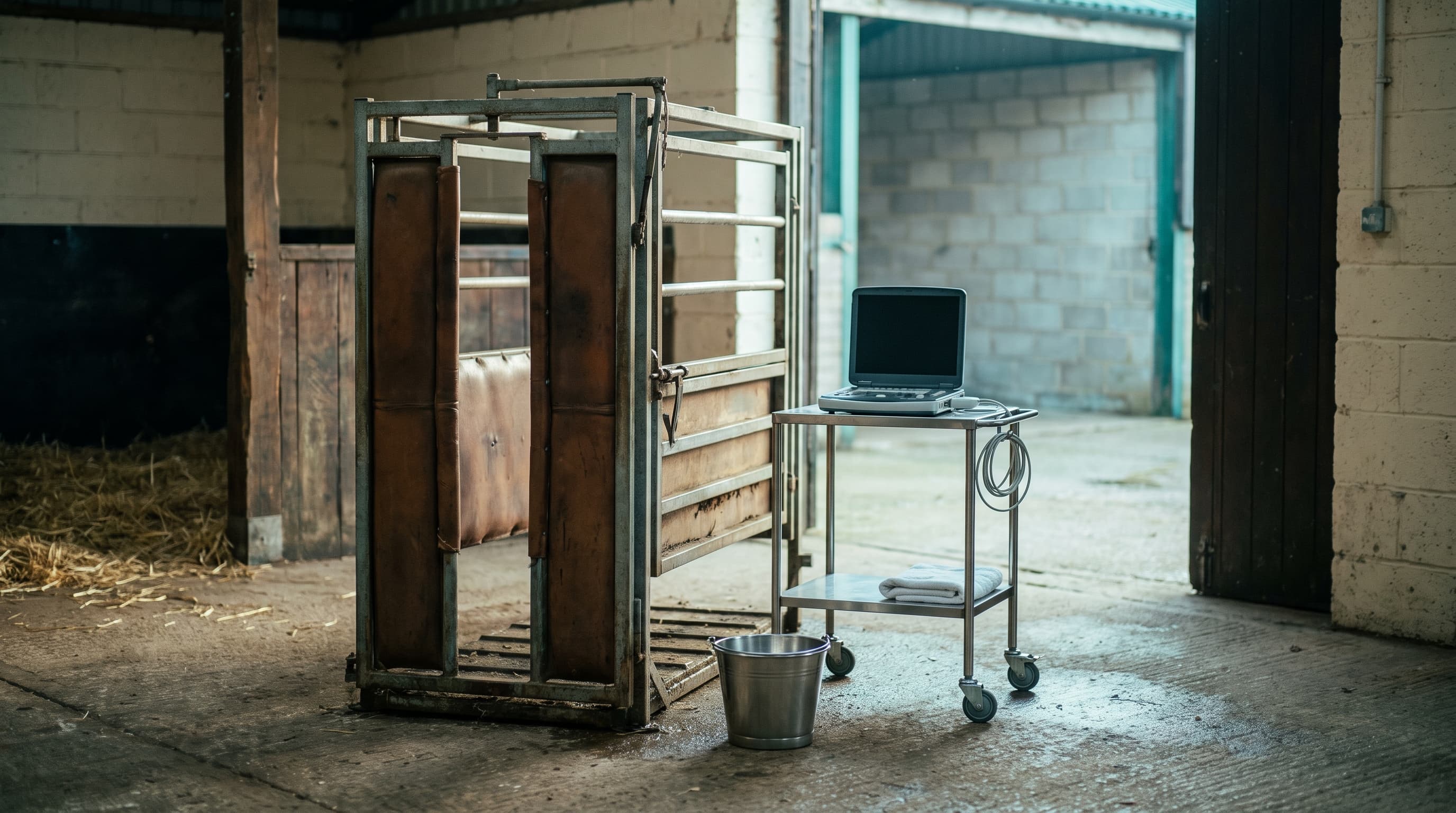
Scan days are counted from ovulation, which your vet tracks, not from the day the mare left for the stud. Colorado State University's equine reproduction laboratory recommends the first ultrasound 14 to 16 days after ovulation. That scan answers two questions: is she in foal, and is there a second embryo. Twins rarely end well in a mare, and the RVC describes reducing them to one between days 14 and 17 as a quick procedure with minimal risk to the mare.
The heartbeat comes next. The Merck Veterinary Manual puts it at 24 to 25 days and suggests a check between days 25 and 30. If none is seen at day 25, CSU advises looking again 24 to 48 hours later before calling it a loss. Around day 35 matters too: a mare found empty then can usually be covered again that season, while one that loses the pregnancy after day 35 usually will not cycle again that year.
From an ovulation on 10 April 2027, that puts the first scan on 24 to 26 April and the heartbeat check from 5 May. Your vet sets the actual schedule, and some will want a later check somewhere between days 40 and 60 and another in the autumn. Book the first two before the mare goes to the stud, so nobody is improvising.
Early, late and when to ring the vet
A foal born before 320 days counts as premature; the IFCE puts it that way, and so does Japan's JRA breeding farm. At the other end, the British study's viable foals reached 388 days, so a long pregnancy on its own is not an emergency. What decides it is the mare and the foal, not the calendar. If she is past her window, shows signs you do not understand, or anything about her worries you, call your vet. This article is not veterinary advice, and the vet who knows your mare decides.
For the money side of a season, from stud fee to scans, see what breeding a mare really costs. If you stand a stallion yourself, the stud's side of the same calendar is in standing a stallion at stud.
Where we fit
Hoofine cannot tell you when your mare will foal, and no calculator can either. What the site does is list stallions and their studs on the breeding pages, so you can compare where to send her while there is still time to plan the date, and point you to equine vets who can scan her. The pregnancy, the scans and the paperwork stay between you, your vet and your studbook.