The price on a riding school's website is rarely the price of riding there. How much are horse riding lessons depends on whether that figure is per lesson, per block or per month, whether a hat and the horse's tack are included, and whether a membership or a federation licence sits on top of it.
This is for the adult or the parent starting out, and for the rider who suspects that lessons are the first step towards a horse of their own. It covers how schools set their prices, how to turn any price list into one comparable number, what should be inside the price, how to tell a properly run school from one that is merely cheap, and where lessons lead.
How riding schools set the price
Ask three schools how much are riding lessons and you will get three answers in three different units. Four things decide the number, and two schools that look the same price usually differ on at least one of them.
- Group or private. A private lesson costs more per hour and teaches more per hour. A group lesson is cheaper, and how much you learn in it depends on how many riders share the instructor.
- Length. Thirty, forty-five and sixty minutes are all common, and a shorter lesson at a lower price is not a cheaper lesson.
- Single lessons or a block. Many schools discount lessons bought in advance as a block or a monthly package, and many of those packages expire.
- Membership and licences. In some countries the lesson is only part of the bill. Riding clubs affiliated to the French federation require every regular rider to hold its licence, which cost €40 for an adult and €29 for a junior in 2026. Japanese riding clubs commonly charge a joining fee and a monthly membership before the first ride is paid for.
How much are horse riding lessons per ridden hour?
No national statistics office in the markets we cover publishes a price series for riding lessons. The figures that circulate online come from individual schools, booking sites and blogs, each describing its own corner of the market. We would rather not add another.
What you can do is make every price list comparable. Take everything you must pay in a year to ride at a school: the lessons you will realistically take, any membership, any licence, any assessment ride. Divide it by the hours you will actually spend in the saddle. That cost per ridden hour is the only figure that lets a group lesson at one school be compared with a private lesson at another, and it is the honest answer to what horse riding lessons cost where you live.
Two things distort it. A package you cannot use before it expires turns a discount into a loss, so count only the lessons you will really ride. And a school that cancels for bad weather without a make-up lesson has quietly raised its price.
What should be inside the price
A lesson price should cover the horse, its tack, the arena and the instructor's time. Ask about the rest before you book:
- whether a riding hat can be borrowed, and what standard it meets
- whether you need your own boots, gloves or a body protector
- whether an assessment ride, a membership or a licence is required first
- what happens to a lesson you cancel, and to one the school cancels
- whether you are insured while riding, and by whom
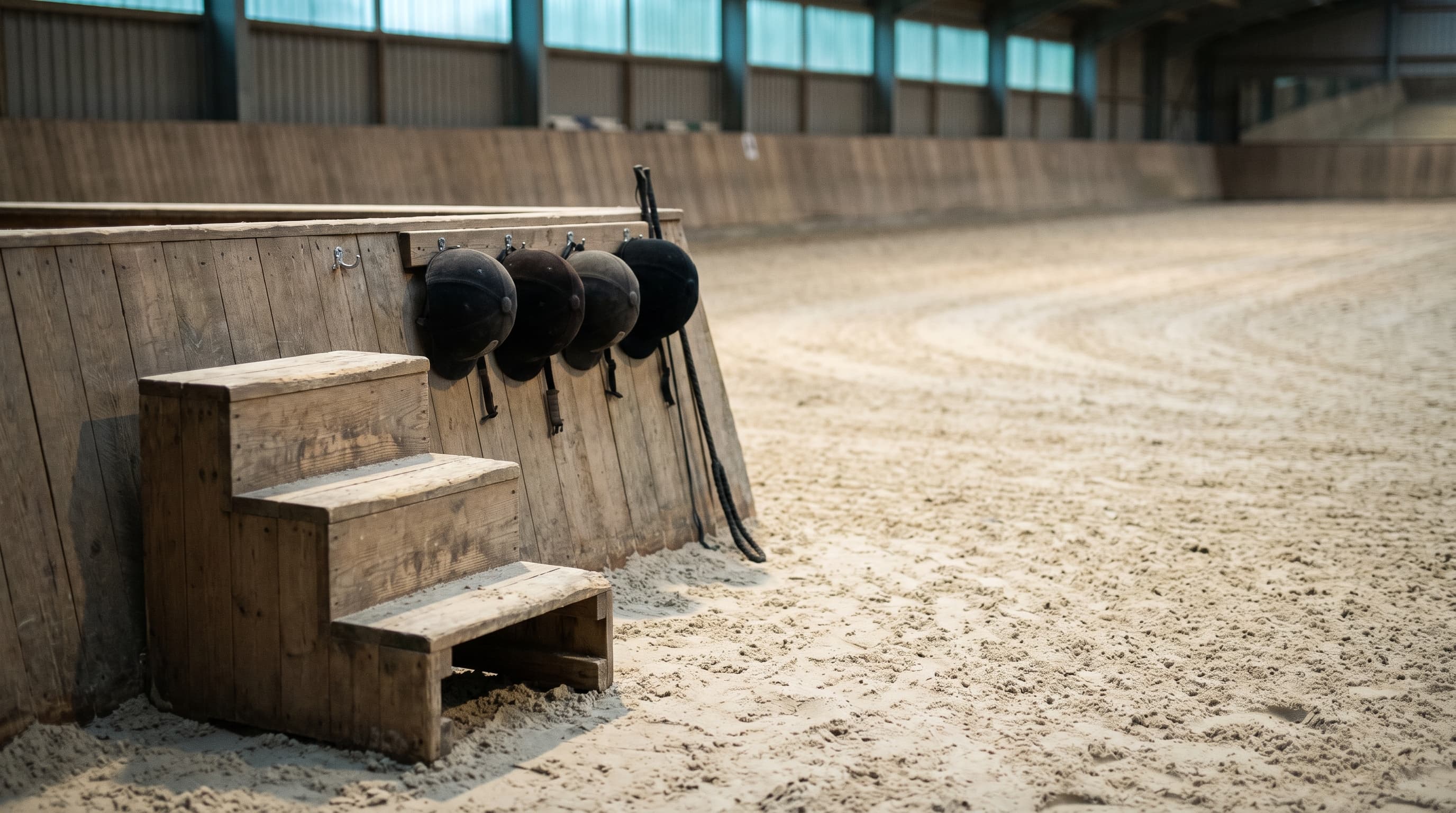
On hats, a useful reference is the British Horse Society's hat rules for its approved centres, which accept standards including PAS 015, VG1, ASTM F1163 and EN 1384:2023, each only with its quality mark, such as a BSI Kitemark or an SEI mark. The BHS also advises replacing a hat after a fall. A school that lends hats should be able to tell you which standard its hats meet.
How to tell a properly run school
Price tells you very little about safety. Regulation tells you more, and it differs sharply between countries.
In England, hiring out horses for riding or for instruction in riding is a licensed activity under the Animal Welfare (Licensing of Activities Involving Animals) (England) Regulations 2018. A licensed school must hold public liability insurance covering its clients, must not leave the activity in the charge of anyone under 18, and is inspected by a vet. The statutory guidance adds that riding hats must meet current safety standards and be worn at all times when mounted, and that at least one member of staff must hold a recognised qualification, such as a regulated Level 3, or have equivalent experience. Licences carry a star rating from one to five, so ask to see the certificate. In Wales and Scotland schools are still licensed under the older Riding Establishments Acts. BHS approval and ABRS+ are voluntary schemes on top of the licence.
In the United States there is no federal licence, but some states regulate: Massachusetts requires every for-hire riding instructor to be licensed by the state. Most states also have equine activity liability laws that limit a stable's liability for the inherent risks of riding, which is why you will see warning signs and be asked to sign a release. Instructor certification through bodies such as CHA, ARIA or the USHJA Instructor Credential is voluntary, and worth asking about.
Everywhere, watch a lesson before you book one. Look at how many riders share the instructor, whether new riders are assessed before being put in a group, and whether the horses look sound, calm and well kept. None of that needs a regulation to be visible.
From lessons to a horse of your own
Lessons are the cheapest way to ride regularly, and for many riders they are the right answer for years. At some point the arithmetic and the ambition change together. The usual next step is not buying but sharing or loaning a horse, which teaches you what daily care involves before you pay for all of it. When buying does come into view, the monthly cost of a horse and what boarding really includes are worth reading before the purchase price, because they are the numbers you will pay every month afterwards.
Where we fit
Hoofine is not a riding school and does not grade them. What it does is put them in one place: the riding schools and equestrian centres in the directory are there to be compared on the questions above, not only on the price of a single lesson. When lessons have turned into a search for a horse, the horses for sale are next door.